Testing a Trash Can Faraday Cage |
November 10th, 2026 |
| preparedness, tech |
The big things here are making sure you have enough water and food for a while, along with critical medications and the standard "prepping" recommendations. But lately I've been thinking about what you might do for other risks, such as engineered pandemics, mirror bacteria, or fire suppression outages. And today, EMPs.
An EMP is an electromagnetic pulse, and a strong one could destroy a lot of electronics. The most likely way we get one in the near future is a high-altitude nuclear detonation. This could be part of a nuclear war, or fighting around an AI takeover attempt.
It's not totally known what effect an EMP would have on stuff. The initial pulse ("E1") is very short and the voltage it induces is proportional to the length of the conductor it hits. The power grid (famously involving long conductors) would be seriously damaged, especially the massive and hard to replace transformers. Unplugged electronics, however, are pretty safe: no long conductors to get high voltages.
The best source I've found on EMPs is the 2008 Report of the Commission to Assess the Threat to the United States from Electromagnetic Pulse (EMP) Attack. They simulated nuclear EMPs and looked at how a wide range of common things were impacted. Generally things were fine as long as they were off and unplugged.
On the other hand, this was all tech from two decades ago, and it's possible that things have changed. Many things now have more resistance to electromagnetism in their design (shorter conductors, more PCBs vs wires, more shielding) but some electronics are more voltage-sensitive (ex: switching transistors from silicon to gallium nitride, smaller transistors generally). One category I'm especially worried about is equipment that's never fully off, because it has a permanently attached battery. For example, I have some LiFePO4 batteries and these have a built in battery management system: an EMP might be able to break this in a way that can't be fixed without opening up the system and disconnecting it, which is pretty risky.
Overall, I think it's pretty likely that for EMP resistance it's enough to leave your equipment off and unplugged. Unless you're excited about testing Faraday cages, make sure your stuff stays unplugged and you can stop reading now.
What if we're wrong and in the past 20y equipment has become more vulnerable to EMPs than we expected? What if you didn't do the research above until after you went and got a galvanized trash can, a noise generator, a radio receiver dongle, and some conductive tape?
The standard way to protect against electromagnetism is a Faraday cage. If you put something inside a metal box, as long as there aren't gaps in the box the electromagnetic field stays outside. A large mass-produced metal box is an Oscar-style galvanized trash can. How much would it help to put our stuff in that? And would it help more to seal the gap between the lid and the body with metallic tape?
I set up a cheap broadband radio-frequency noise generator with a 29" telescoping antenna, powered by the 12v power supply from an AirFanta 3Pro. Since I knew this needed to work inside a trash can, I used my Anker SOLIX portable power station instead of the wall. I also put a cardboard tube around the antenna and put the base in a cardboard box, so that it wouldn't touch the body of the trash can. The goal was to block electrical connections, without affecting the radio signal.
To pick up the signal I used a Nooelec NESDR SMArt v5, attached to my laptop. This has a very similar antenna, and I set it up a ~foot from the noise source antenna and parallel:
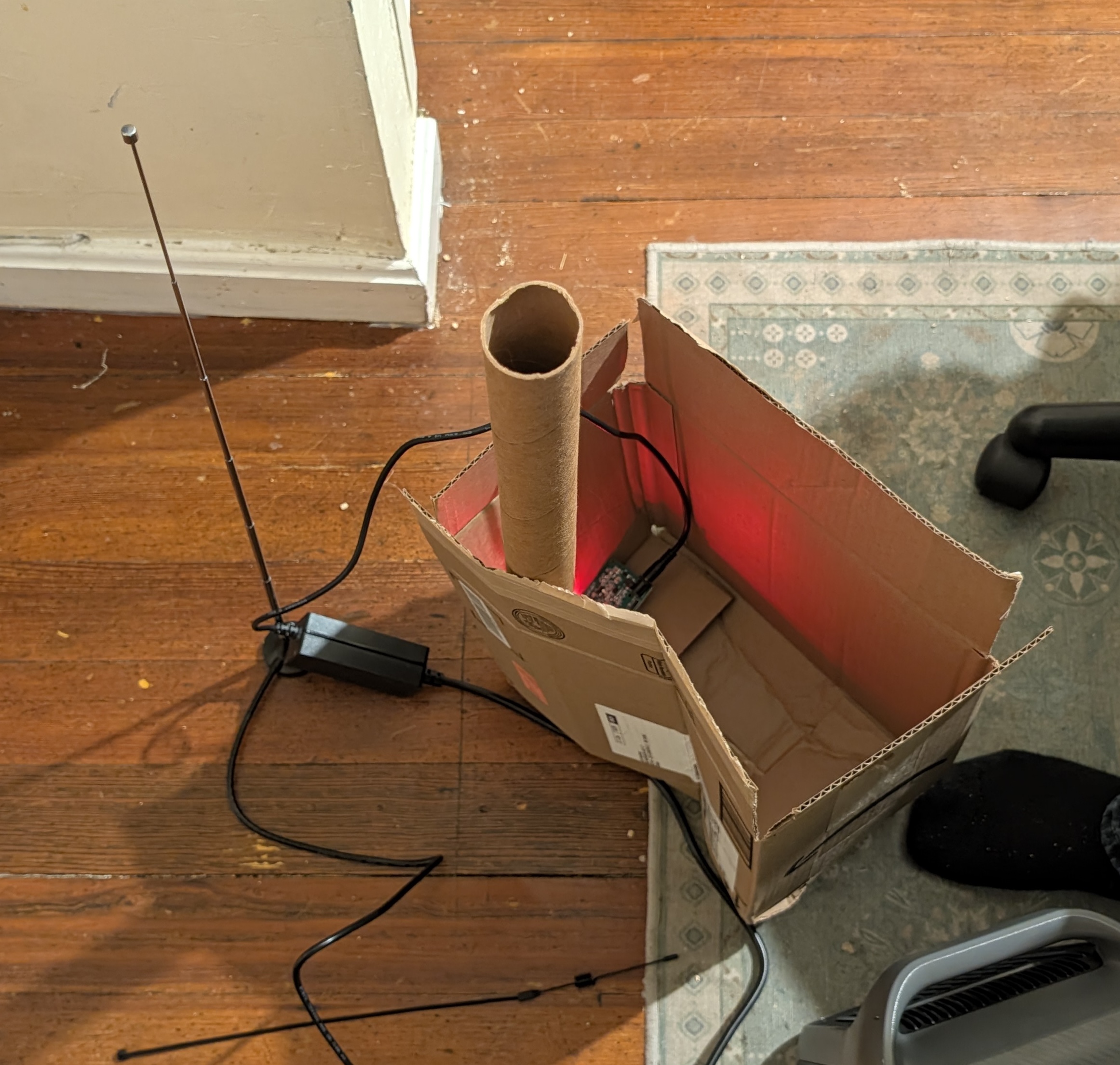
I compared this to the same setup with a trash can around it:
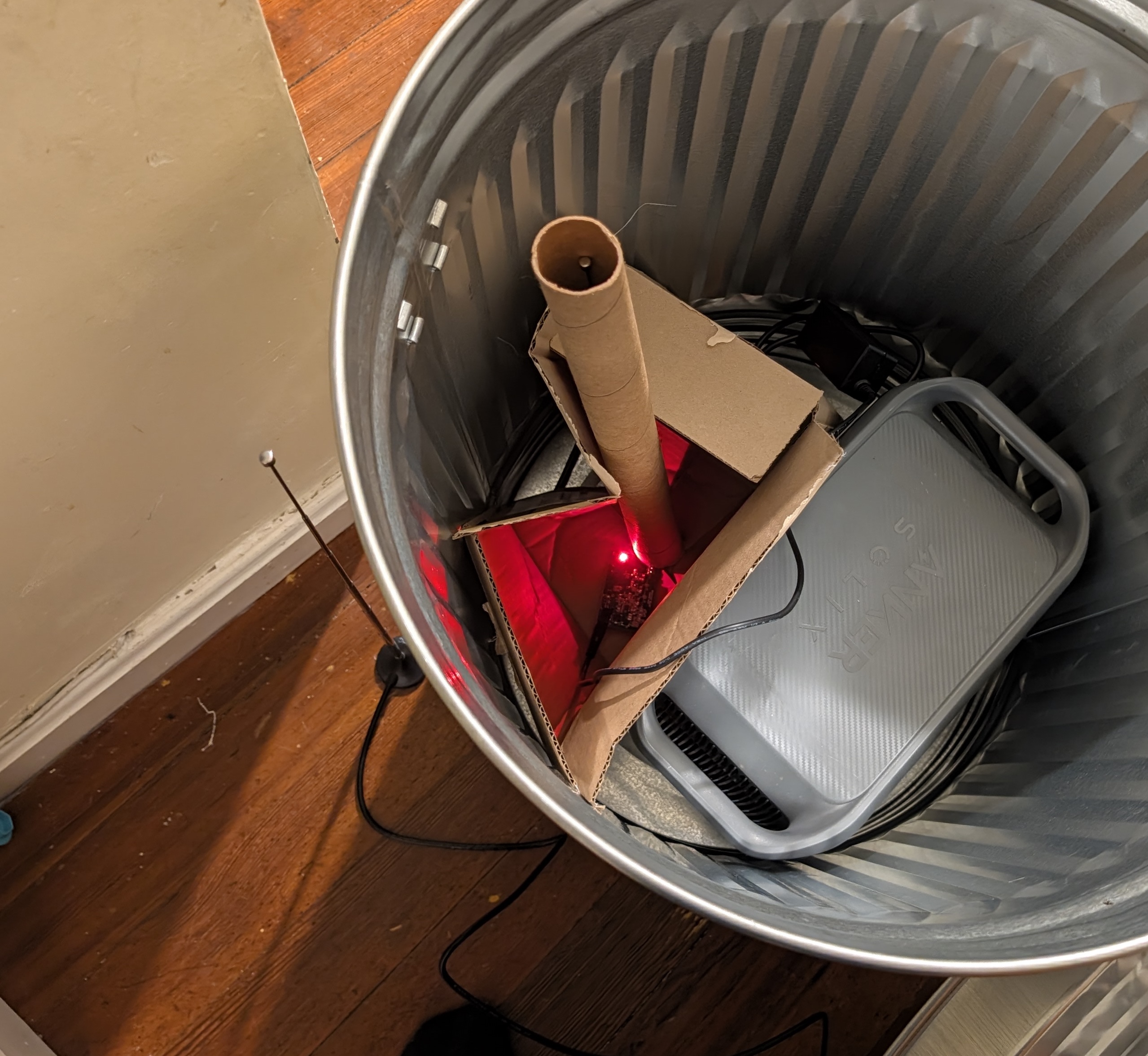
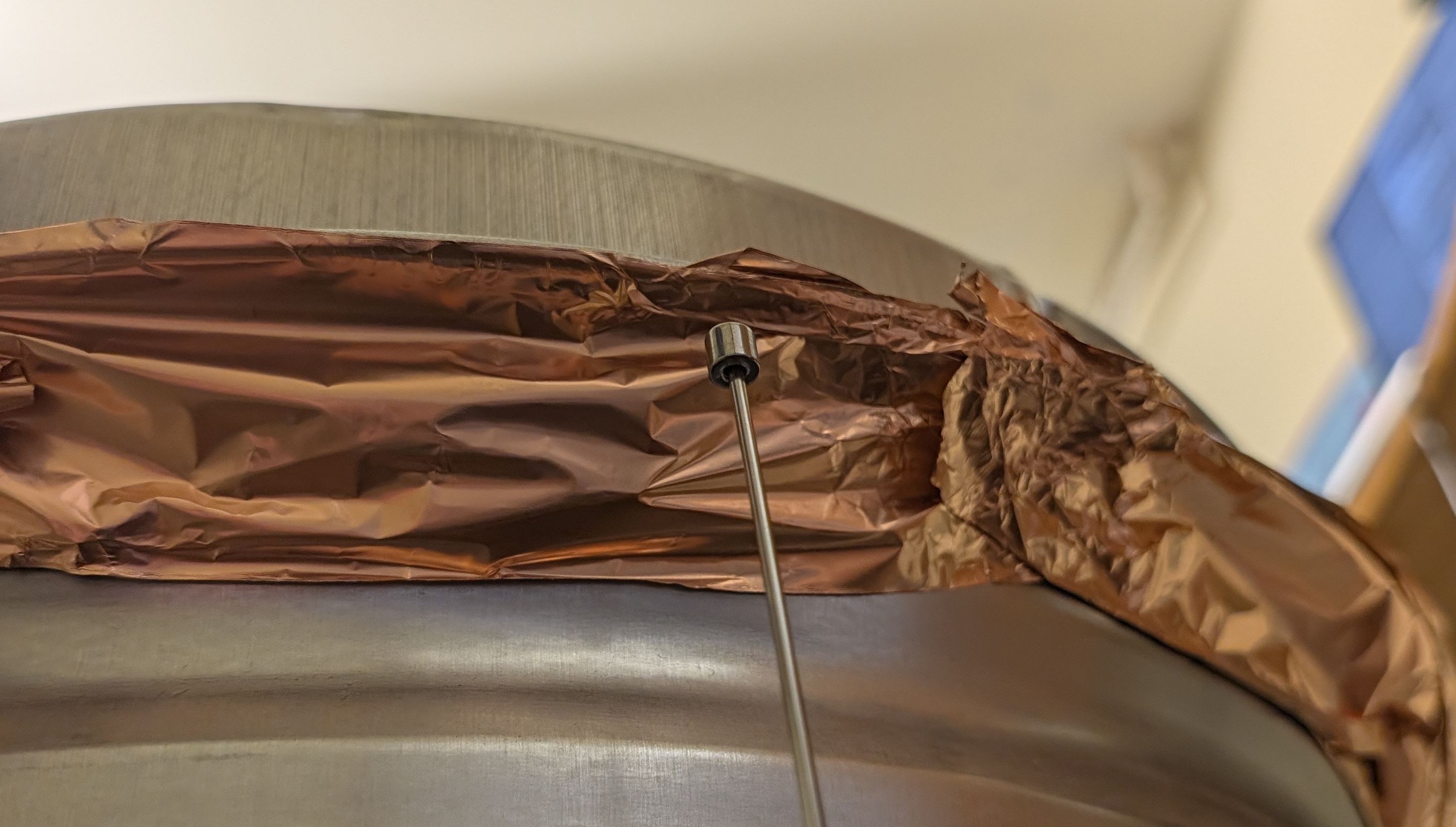
I tested both with the lid on, and with the lid on and also seam taped:
Technically I'm measuring in the "wrong direction" since I would be very surprised if an EMP were initiated inside a trash can in my basement, but shielding works the same in both directions so this doesn't matter. How much noise gets out in each of these tests tells us how the configuration changes how much of a pulse would get in.
I had Claude write the software and run the measurements. It steps the radio receiver from 24 MHz to 1.7 GHz (its full range) and records power in each 100 kHz slice. We tested:
- Source off (background: FM stations, cell towers, the receiver's own noise)
- Source on and no can (reference)
- Source in the can with the lid off
- Source in the can with the lid on
- Source in the can with the lid on and taped
Here's what I found, in dB. Every 10 dB is a factor of ten, so 30 dB means only 0.1% of the power got through:
| Band (MHz) | Limit of detection | Lid off | Lid on | Lid taped |
|---|---|---|---|---|
| 25–50 | 20 | ≥20 | ≥20 | ≥20 |
| 50–100 | 21 | ≥21 | ≥21 | ≥21 |
| 100–200 | 29 | ≥24 | ≥25 | ≥25 |
| 200–400 | 29 | ≥28 | ≥29 | ≥29 |
| 400–800 | 35 | 19 | ≥31 | ≥30 |
| 800–1200 | 45 | 18 | ≥43 | ≥45 |
| 1200–1700 | 47 | 22 | 29 | ≥46 |
A "≥" means I couldn't detect the source at all, so we just have a lower bound on the reduction, determined by our ability to distinguish the source from background (limit of detection).
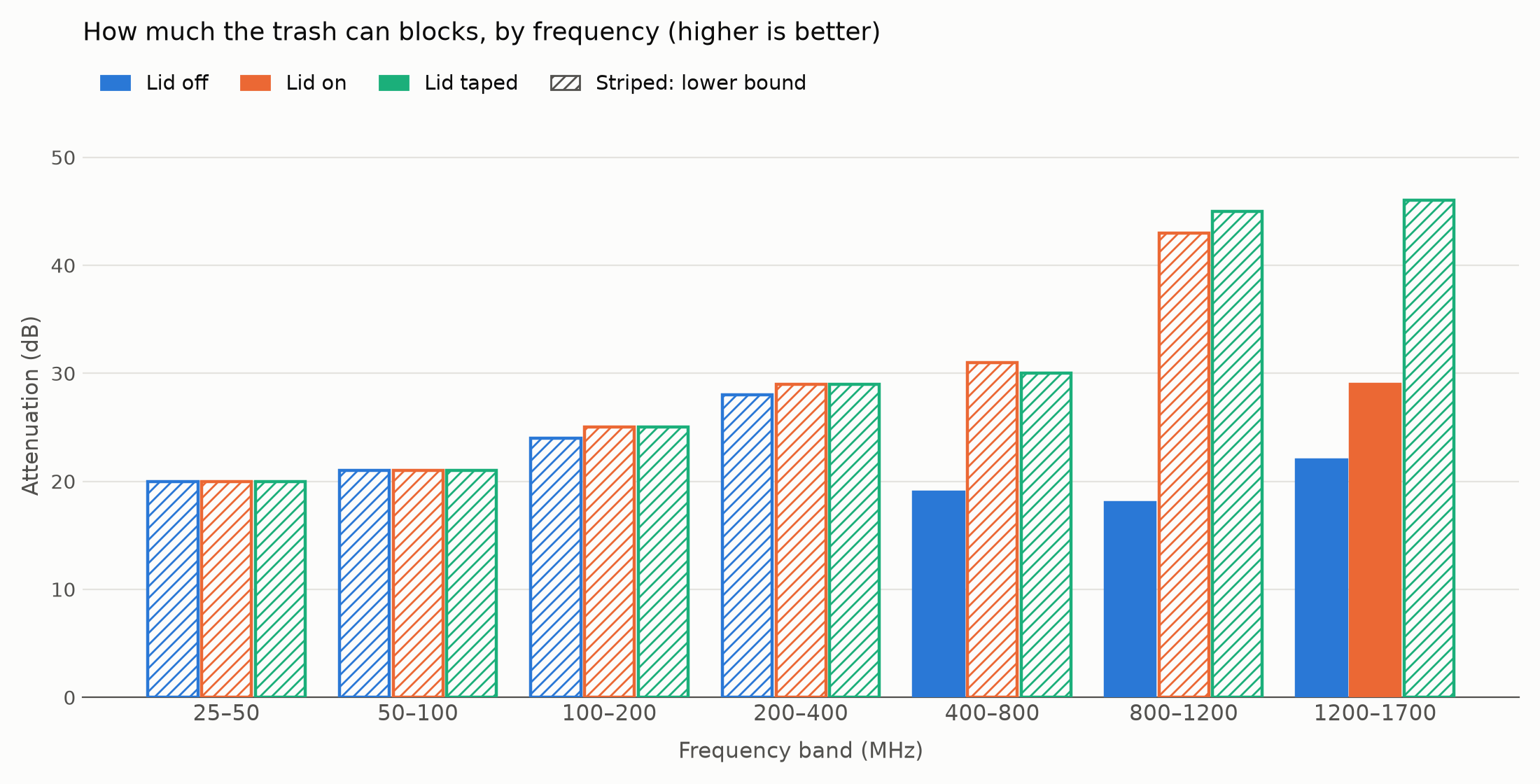
Notes:
A lot of this is lower bounds. The receiver only has about 45 dB between noise and overload, and less than that at radio station frequencies.
The lid does leak at the seam. At the highest frequency (1.2–1.7 GHz) it's ~29 dB, with dips down to ~20 dB, and there was also a very narrow leak at 339 MHz where the can did ~nothing. The lid makes good contact with the can most of the way around, but there are four spots, evenly spaced, where the rim has ~1cm gaps to let the lid flex. I think these are the most likely culprit, though I haven't confirmed it.
Taping the seam fixes the leak. Once I taped all the way around I didn't detect the source at any frequency, including the problem frequencies above.
The "lid off" test isn't realistic. The wall of the can is between the source and receiver, but a real EMP could come from above.
The largest issue with this test is that most of the problematic EMP is below 100 MHz where my test is weakest. Short antennas don't work well down there, there are strong broadcast signals to compete with, the dongle can't go below 24 MHz, and Claude tells me that with the antennas a foot apart we're testing electric field blocking more than magnetic field blocking. [1]
Still, we already have very good reasons from physics to expect the can to work very well at low frequencies. The steel wall itself is effectively opaque at these lower frequencies, and the question is the seam. Gaps leak less as the wavelength gets longer relative to the gap, and Claude estimates (from physics) 30–60 dB with the bare lid and 50–80 dB taped in the 1–100 MHz range.
Overall, while I'm still not sure a Faraday cage is needed, if you do want one a taped trash can should work very well.
[1] I did try one more test: I set the receiver to the strongest AM
radio frequency I could find (WBZ at 1030 kHz),
set it to play loudly through my laptop speakers, and closed the lid
with the whole assembly inside. I couldn't get this to work very
well, though, I think because I have an antenna that's a terrible fit
for AM. I did see a lower bound of 40 dB of attenuation putting it in
the can, but that was even with the lid open. I may try more later
and see if with a better antenna I can measure the lid effect. Still,
40dB is likely plenty.
Comment via: facebook, mastodon, bluesky