Running An Air Purifier on Batteries |
June 3rd, 2026 |
| , airquality, battery, preparedness, tech |
I've been thinking about DIY biohardening, primarily to reduce risks from environment-to-human threats, and a lot of what's out there assumes the power grid stays up. This doesn't seem like a good assumption: even if society does a fantastic job protecting essential workers and prioritizing keeping the grid up, I expect many more outages than we have today, and longer ones. If an outage means you lose positive pressure and get sick, that's really very bad!
If I needed to build a DIY cleanroom today, I'd start with my AirFanta 3Pro. While it being HEPA is overkill for cleaning the air that's already in a space, it's great if your goal is to clean air as it enters a space.
The simplest option is to buy a portable power supply. I have the 1,056 Wh Anker SOLIX c1000 and at $450 on Amazon it's comes to $0.43 / Wh. If I trust AliExpress, I could maybe get it for $322 ($0.31 / Wh). These look to be pretty typical for portable power supplies, and I like that the SOLIX supports solar charging.
Another option would be deep cycle AGM lead-acid batteries. This is what I went with in 2018. Doing some reading now, though, it seems like they're rarely worth it anymore. A 100Ah AGM, which you should really only take 50 Ah of, is $160, and a 100Ah LiFePO4, which can be discharged down to 80-100%, is $147. Plus the LiFePO4 is less than half the weight: 24lb vs 57lb.
Unlike the portable power supply, version, this requires assembling a few components:
A coulomb counter shunt, which tells you how much power you've drawn so you know how much is available and whether you're almost out. ($16.19)
A fuse holder and fuses, so a short circuit doesn't start a fire or destroy your battery. ($1.70)
Connectors, so you can easily connect and disconnect without worrying about messing up polarity and destroying something. ($4.66)
Charger, so you can bring the battery back up to full when you have access to power again. ($18.99)
I already had all of this from my earlier inverter project, except for the fuse (integrated into the inverter) and connector to the AirFanta (which takes a 5.5mm x 2.5mm center-positive barrel jack). Hooking it all up, I can run my AirFanta off grid:
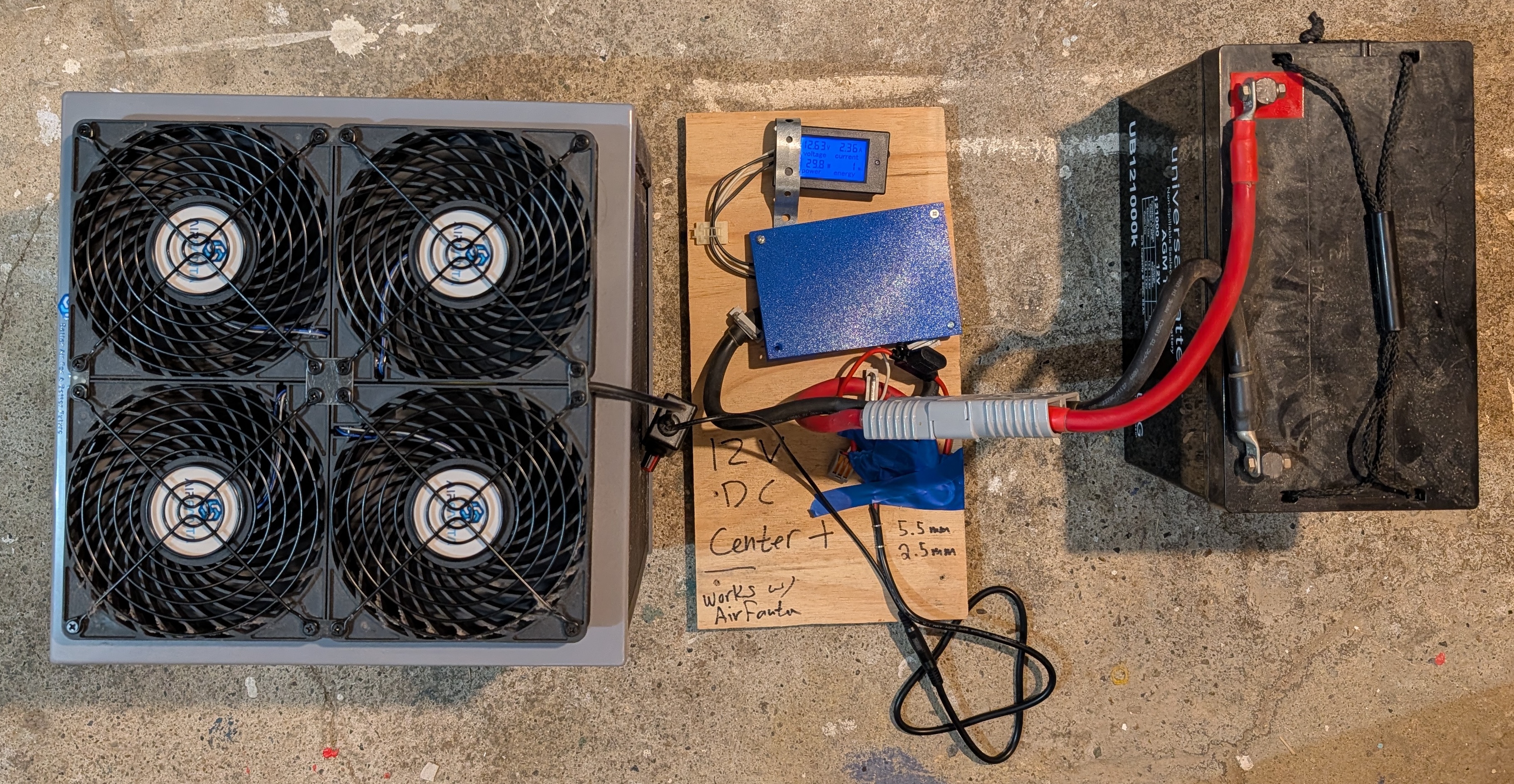
If I didn't already have most of this, I'd have been spending $188 for 1280 Wh, or $0.15 / Wh. This is much better than the portable power supply, it also provides much less: I can only use it to power things with 12V DC.
Now, you might imagine someone would sell a box that wraps a battery and provides these extras so you don't need to DIY anything, but as far as I can tell this doesn't quite exist. People sell "battery box power centers" for use on boats, but they don't measure how much power you've drawn. With a modern LiFePO4 battery this is a big issue, because you can't really estimate power from voltage. These boxes also don't provide charging: on a boat that's not a feature you're looking for. So I think full featured portable power supplies and DIY setups are the two main options.
Personally, I'm glad to have both systems:
The Anker SOLIX portable power supply is much more flexible: it powers things over AC, provides USB ports, charges very quickly from the wall if power is available, and can be recharged by solar.
The DIY 12v system is simpler, less likely to break, modular and easy to fix, and cheaper. If I want to go bigger, I can expand my total capacity just by buying additional batteries at $0.11 / Wh.
I can also move power between the two systems with relatively low losses, to take advantage of flexibility or capacity as needed.
I'd really like to know how much power this would draw and how long I could run it for, but without actually building something and taking measurements all I can do is estimate. A big question is whether it could get to useful levels of pressurization: I don't think it would get anywhere close to +75 Pa, but maybe +10 Pa would still be possible and good enough if we can avoid wind by pressurizing something inside an existing building? For now I'll set all that aside and look just at the case that's easy for me to work with: running the air purifier as it's designed to be operated.
So: how long can I run the AirFanta for? What setting should I use if I want to maximize my clean air delivery rate (CADR)?
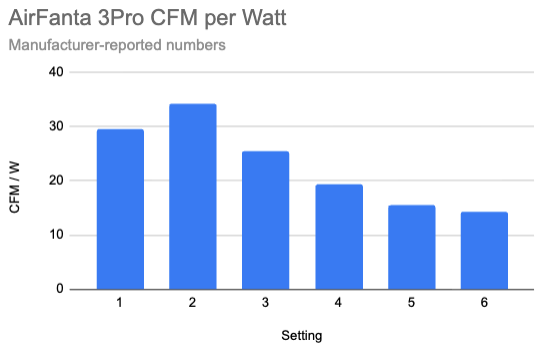
The manufacturer gives power and throughput numbers, but I expect slightly lower power usage from running it directly on DC. They report 33.2W on the highest setting while I measured 29.2W, so this looks like a factor of 14%, just around where you'd expect. Scaling down by that factor, and calculating CFM per Watt, I get:
| Setting | Power (W) | CFM | CFM/W |
|---|---|---|---|
| 1 | 1.93 | 57 | 30 |
| 2 | 4.12 | 141 | 34 |
| 3 | 9.74 | 247 | 25 |
| 4 | 16.58 | 321 | 19 |
| 5 | 24.04 | 374 | 16 |
| 6 | 29.12 | 413 | 14 |
You can see that setting 2 is the most efficient but also produces less air: if you have unlimited purifiers you should run them all on 2, but if you need more output you might need to run them higher to get sufficient CADR.
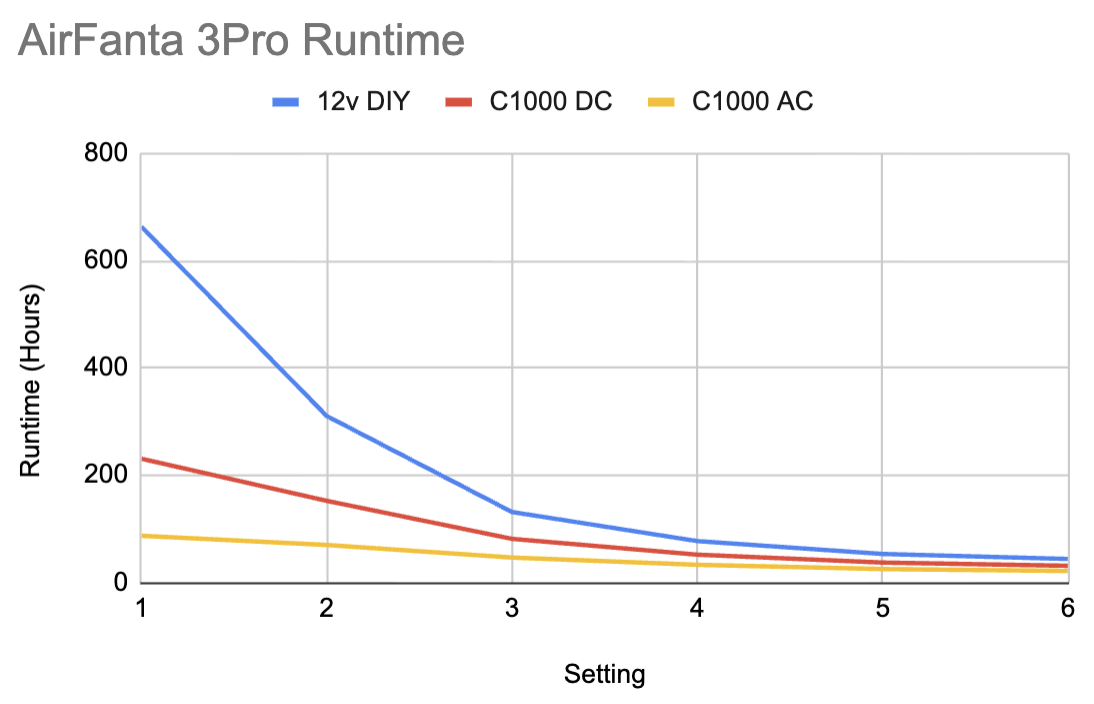
We can also estimate the runtime we'd get at different speeds. I'll model the 12v DIY system as a 100Ah LiFePO4 12.8v cell (1,280 Wh) while the Anker C1000 is 1,056 Wh. [1] I'm estimating that the C1000 loses 2.5W just by being on, an additional 7W if it needs to run the inverter, loses 7% on DC-DC conversion (12V port) and 14% on DC-AC conversion (AC outlets). So I'll model the 12V DIY system, the C1000 via the 12V port, and the C1000 via the AC ports (where we then lose another 14% on AC-DC conversion):
| Setting | 12 DIY | C1000 DC | C1000 AC |
|---|---|---|---|
| 1 | 663 | 231 | 87 |
| 2 | 310 | 152 | 70 |
| 3 | 131 | 81 | 47 |
| 4 | 77 | 52 | 33 |
| 5 | 53 | 37 | 25 |
| 6 | 44 | 31 | 22 |
The effect of overhead on runtime is substantial, especially at low draw. On setting #2, producing 141 CFM, the DIY system should be able to run for just under thirteen days, the C1000 with DC for just over six, and the C1000 with AC for a little less than three. At higher draw this is less of a concern, since if the fan needs 29W losing 2.5W (or even 9.5W) to overhead matters less.
This pushes the analysis much more in the direction of the DIY system, especially if lower current is enough.
[1] Because the LiFePO4 cell has charge limiting circuitry built in,
it's ok to run it to 0%: it will just shut off. While you shouldn't
store it fully discharged, in this case I'm imagining we recharge it
promptly. This means we get the full capacity from both batteries.
Comment via: facebook, lesswrong, mastodon, bluesky