Storing Food |
February 22nd, 2026 |
| food, preparedness |
It's hard for me to really imagine living through a famine. The world as I have experienced it has been one of abundant calories, where people are generally more worried about getting too many than too few. Essentially no one dies in the US from food unavailability. Globally, however, it's different: each year millions die from hunger.
If you look at the circumstances of modern famines, they're downstream from systems failing. Society was functioning well enough that most people got enough calories, then something went seriously wrong, most likely war. This is one of the reasons that it's hard to use donations to reduce hunger deaths: getting food to people stuck in war zones is very hard.
This means from an altruistic perspective I feel torn: the current situation is horrible, but it's also not where I think my donations would go farthest and so it's not where I donate. This is the painful reality of living in a world that is far worse than it could be, doing what we can and knowing it's not enough.
I also look at famine from a selfish perspective, however, thinking about how this risk might impact me and the people I most love. [1] As someone whose day job involves trying to reduce rare-but-catastrophic risks, I do think global famine is plausible. Our systems are robust to localized problems, but much less so to widespread disasters. Storing food to reduce the worst outcomes seems worth doing. [2]
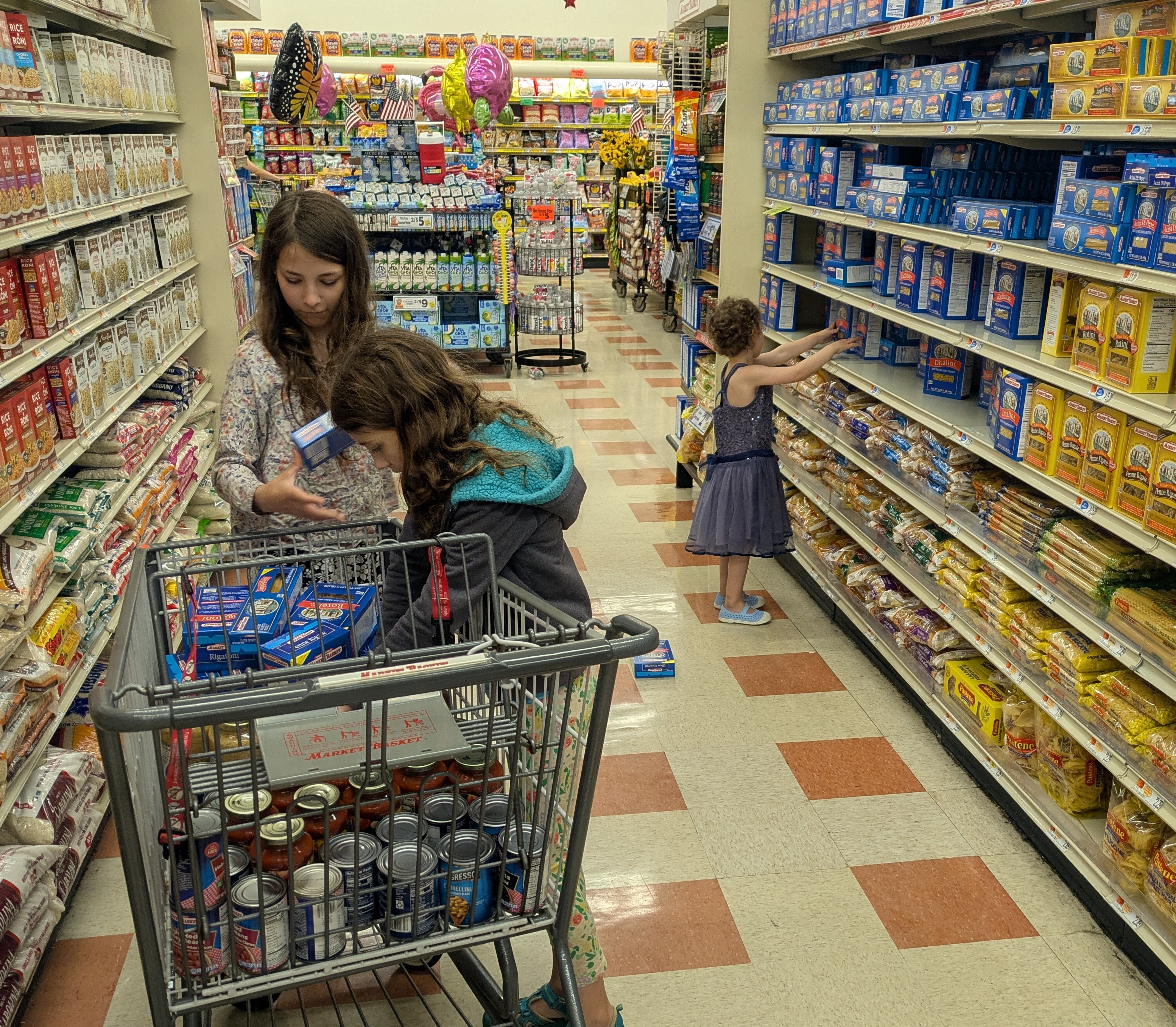
The approach we take is buying extra of the non-perishables we usually eat, and rotating through them. Our main cost is in buying some food earlier than we normally would. We eat a lot of pasta and beans, and a pound of pasta and can of beans give about a person-day of calories and protein for $2, or $60 for a month's worth.
The $60 cost isn't the real number, though, because you're investing: you can always eat this food later if you need the money. If the market would give you a 5% real return and the value of food roughly tracks inflation, the annual cost of keeping $60 as food is $3 ($60 * 5%). I think this is worth doing for most people until you bump into the limit of what you have space to store or what you'll rotate through before it spoils, and may be worth it beyond that depending on how likely you think the risks are.
Aside from the tail-risk reduction, there are also day-to-day benefits of having more food on hand. We can go to the grocery store less often, buy a larger proportion of our food when it's on sale, go to the farther store that charges less, and cook more things without going to the store. [3]
Like many preparedness questions, a lot of this comes down to how much space you have. When we were living in apartments, moving ~yearly and where each sqft counted, we only did a little of this (buying extra pasta). But now that we're in a house (where I strongly hope to never move again) and generally have more space it's worth it for us to do a bunch more. Something to consider next time you're at the store?
[1] Having kids made me feel much
more strongly here. I already did this
some before having kids because it seemed reasonable, but the idea
of them not having enough to eat is viscerally horrifying in a way
that's hard to think or write about.
[2] A rough EV estimate: storing three months of food costs $180 up front and so $9 in lost returns annually, not having enough food in a 3-month famine might give a 5% chance of death, and perhaps you value your life at $10M. This gives a conditional benefit of $500,000, and means it's worth it as long as you think your annual odds of experiencing a 3-month famine are at least 0.002%. Alternatively, if you're not the kind of person who would actually rotate through food let's imagine you buy rice and beans. White rice lasts ~indefinitely if you keep it dry and keep out the rodents; canned beans are edible and nutritious well past their sell-by, perhaps 10y. Rice is a bit cheaper than pasta, but buying a rodent-proof tub to keep the bag in adds some cost, so let's say it's still $180 for a three-months better-than-starvation option that lasts you 10 years. Then it's worth doing as long as you think annual risk is at least 0.004%.
[3] For example, this evening Lily decided she wanted to cook dinner, making a vegetarian curry she'd learned from a friend. It turned out we already had everything in her recipe on hand, with a few substitutions (ex: canned tomatoes instead of fresh).
- Chicken-Free Egg Whites
- Your Supplies Probably Won't Be Stolen in a Disaster
- Gelatinizing Starch in an Emergency
- Personal Effort to Reduce Biorisk
Comment via: facebook, lesswrong, bluesky, substack