Making a Standing Desk

March 7th, 2020
standing, tech
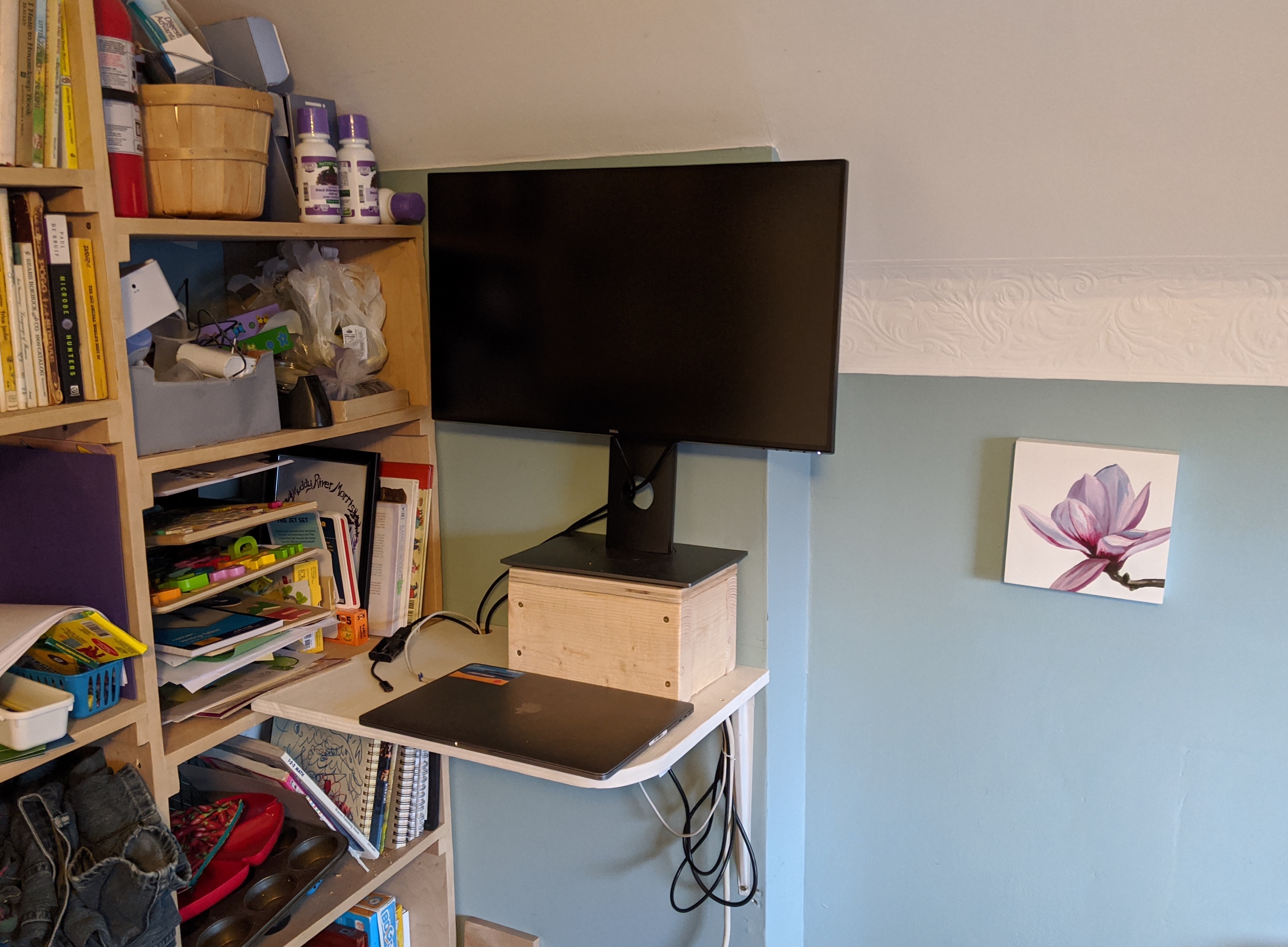
With it looking like I might need to remotely for a while I've been thinking about how to make that more ergonomic. There's no position where I can use a laptop for very long without hurting either my wrists or my neck. A couple months ago I made a folding couch monitor to use while sitting, but (a) that's in the living room and (b) I generally prefer to work standing up. So I made a small standing desk in our bedroom:

It's a one-monitor version of my work hardware setup (which is still the same three years later, except that I have 27" 2560 x 1440 monitors now). I use the laptop keyboard and trackpad because that feels better on my wrists than any external keyboard and mouse I've tried, and I don't use the laptop monitor because that hurts my neck.

While I'm calling it a desk, it's really a shelf. It was easier to attach a shelf to the wall with brackets than build something freestanding, and a standard desk would take up a bunch more space.

It's very small, but all I need is space for a monitor and my laptop. The top is a 22.5" by 17" piece of 3/4" plywood painted white. I rounded the outside corner for safety. I could have made the top a couple inches narrower if I hadn't been trying to match a specific space. It's 41" off the ground, which is in the ~2" window where my elbows can be close to a right angle.

The monitor stand doesn't go high enough on its own, so it's elevated 6.25" with a 10.5" by 7.5" pine box. I made it out of 2x6 scraps I had, with a 3/4" plywood top for the monitor stand's base to sit on. I didn't paint this, though I might at some point.

I'm pretty happy with it, though all I've used it for so far is writing this post.

Referenced in:

Comment via: facebook, lesswrong, substack

Recent posts on blogs I like:

“We should be more ambitious with the software we build”

Since early this year, Michael Malis (of pgrust) has been showing me interesting things he's done and saying [W]e should be more ambitious1 with the software we build There is, understandably, a lot of skepticism about projects like pgrust because there…

via Posts on October 24, 2026

The DBT guide to intense negative emotions

This is a guide for handling intense negative emotions, based on dialectical behavior therapy.

via Thing of Things October 23, 2026

Was the HuggingFace hacking incident scheming?

In July 2026, internal OpenAI agents hacked HuggingFace (HF) in order to figure out how their evaluation grader works. This involved a thousand agents coordinating on an improvised message board to carry out an elaborate sequence of exploits. A later grou…

via Victoria Krakovna October 18, 2026

more     (via openring)