Fifteen Years Aboard |
April 18th, 2026 |
| bida, contra, organizing |
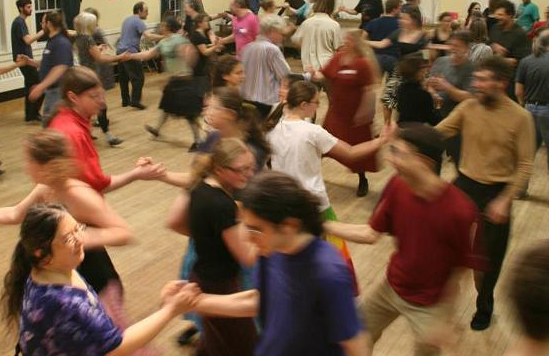
It immediately became my favorite dance. I started volunteering, first out of frugality (volunteers get in free!) and then out of a sense of wanting to contribute, and in 2010 I joined the board. Over the past 16 years I've done just about everything at some point except treasurer, and now I'm stepping away.
It's not that I think BIDA is doing something wrong; quite the opposite! We're seeing record attendance, finances are good, so many fun dancers, and many people who want to pitch in. I noticed I would have been the seventh person running for three board spots, and realized it was a good time to let someone else have a turn. I'm excited to see what Emma, Harris, Bret, Veer, Casey, Naomi, Clara, and Persis do!
This seems like a good time to look back over how BIDA and the Boston dance community have changed over my time organizing.
The biggest change is that BIDA is now Boston's main contra dance. This is kind of hard for me to believe, since we spent so many years as a small dance that tried to fill niches that were not well covered by the many other area dances. We've gone from essentially not booking established bands to booking them regularly, and with our attendance-based bonuses are one of the best-paying dances in the country. I do really enjoy the higher level of musicianship now, but am also really glad Boston Open Contras exists (along with BIDA's open bands and family dance bands) to provide a lower-stakes environment.
The next largest change is probably the switch to gender-free calling (more history), and the level of role freedom that has come along with that. In 2010, I (and many others) would happily dance both roles, but if I was dancing the 'lady' role I had to be 100% on it because if anything went wrong it was my fault. Beginners were strongly discouraged from dancing 'switch', which also discouraged same-gender couples. And while this never happened to me in Boston, conservative men elsewhere would occasionally refuse any sort of physical contact if I encountered them in line while dancing 'lady'. When I look at the dancers now, it's amazing how people have really taken up this freedom to dance any role with any partner, which I feel really good about.
Some smaller changes:
-
BIDA went from 1x/month to 3x/month, most recently by adding a monthly afternoon dance. Since we take the hottest part of summer off, this means going from ~10 to ~28 dances annually.
We now have a dance weekend, Beantown Stomp. I kicked this off in May 2018, we had our first one in March 2019 and it's now an established and anticipated event that people fly to from across the country. I'm especially grateful for Naomi for taking the lead for 2023 (and beyond!) when I was too burnt out on organizing cancelled events (2020, 2021).
We have occasional family dances and livetronica (Spark in the Dark) events.
Our events are still intergenerational, but differently so. In 2010 most dancers were baby boomers; while BIDA was unusual in how many millennials we had, we were still 50%+ baby boomers. At this point I'd guess our dances are fewer than 10% baby boomers: many have aged out of dancing, and many millennial-and-younger dancers have joined. This is also reflected in the board's focus: the initial board was primarily mid-20s people thinking about how to get more 15-35yos dancing, but since we've succeeded at this it's no longer a focus.
We now schedule (and pay) hall managers. In 2010 we just expected most board members would be at most dances and this would give us enough coverage.
BIDA is a lot more organizationally mature. Minutes from the early days say things like "We agreed not to have a President. Instead, we'll use everyone in the board to make sure that we stay on top of things." This turned out not to work very well, and instead specific roles are in charge of staying on top of specific things, with the intraboard coordinator handling things by default.
We were still bouncing around between a few halls, and now we're always at the Cambridge Masonic Hall.
We're a legal entity now, incorporated as a Massachusetts non-profit.
We set up a safety policy, with a committee to handle issues as they come up.
There used to be a lot more of a mentoring focus. Early dances were often two experienced musicians plus a new musician. Callers would typically have a shadow. Every dance allowed sit-ins (off mic, behind the band). We hosted jams about as often as dances. I see this change as pretty natural, and I think a lot of this is now happening informally outside of BIDA.
Organizing BIDA has been a big part of my identity, but I think it's healthy for the organization to have people cycle through, and I'm confident it's in good hands. Very excited to start attending dances just as a dancer, with no formal responsibility!
Comment via: facebook, lesswrong, mastodon, bluesky, substack