The US Already Has A Wealth Tax |
August 19th, 2020 |
| money, policy, taxes |
Even a 0.5% wealth tax would start to keep founders away from a state or country that imposed it.The US, however, effectively already has a ~0.3%-0.4% wealth tax.
Specifically, the long-term capital gains rate in the US is 20% for
high earners (like the startup founders Graham describes) and the IRS
taxes nominal gains. This means that part of what they're taxing is
real gains, but another part is imaginary gains due to inflation.
This is not exactly the same curve as a percentage wealth tax, because
while it starts at total inflation * capital gains it
asymptotically approaches the capital gains tax rate. You can see
this in the extreme: if inflation is high enough or you hold your
money long enough, effectively everything you have is capital
gains, and when you sell you'll be taxed at the capital gains rate.
Inflation is about 2.4% (the annual CPIAUCSL change from January 1990 to January 2020) and the long-term capital gains rate is 20%, so we have something close to a 0.4% wealth tax over 20y, or a 0.3% wealth tax over 50y:
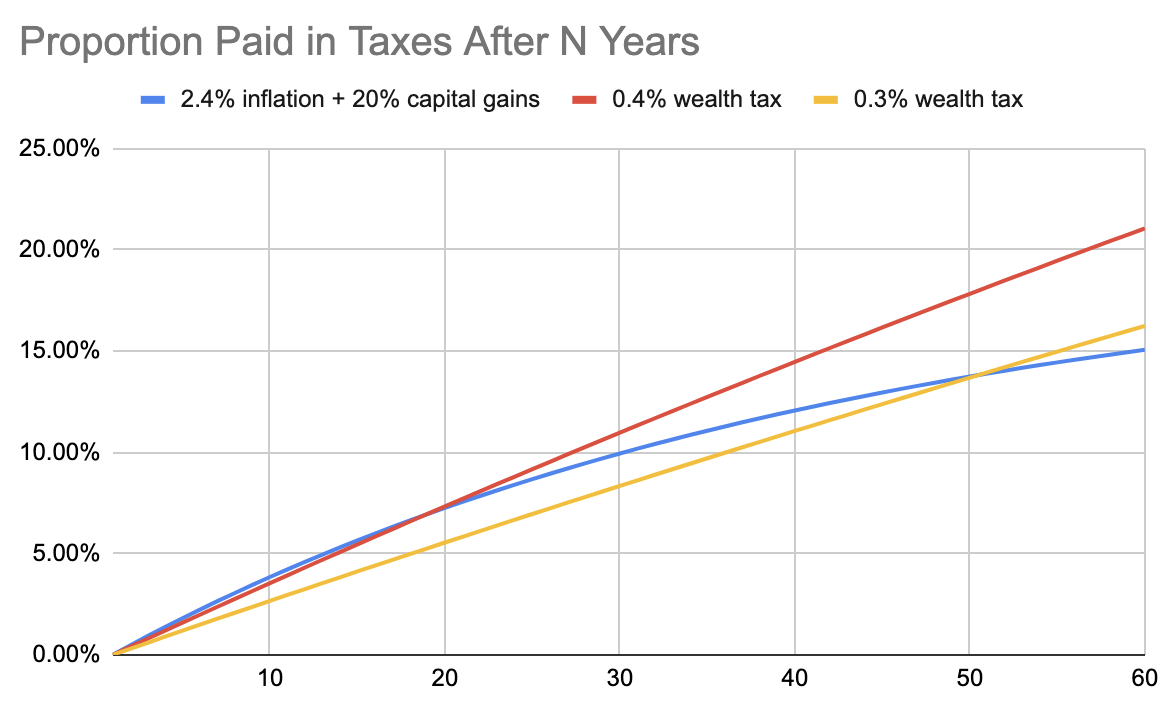
(sheet;
shows a real interest rate of 0% for illustration purposes)
To be concrete, imagine you had $100 in 2000, and invested it in the US stock market. In 2020 it's worth $250 and you sell it. Your nominal gain is $150, and that's what the IRS will tax you on. But your real gain is only $100; the rest is 2020 dollars being about 2/3 as valuable as 2000 dollars. Taxing this difference is taxing wealth.
This makes me think that Graham is overstating his claim, since the US is very popular for startups and has a wealth tax nearly as high as he discusses.
Comment via: facebook, substack