Reading Dudley and Jacqueline's Barn Dance Book |
July 22nd, 2026 |
| contra, music |
As part of my project on understanding attitudes towards live music I thought I would read some of his own words. Most of his words were poems, though, and I generally prefer something more concrete and direct. He did co-write a 2009 book with Jacqueline, however, Traditional Barn Dances with Calls and Fiddling, which seemed more promising.
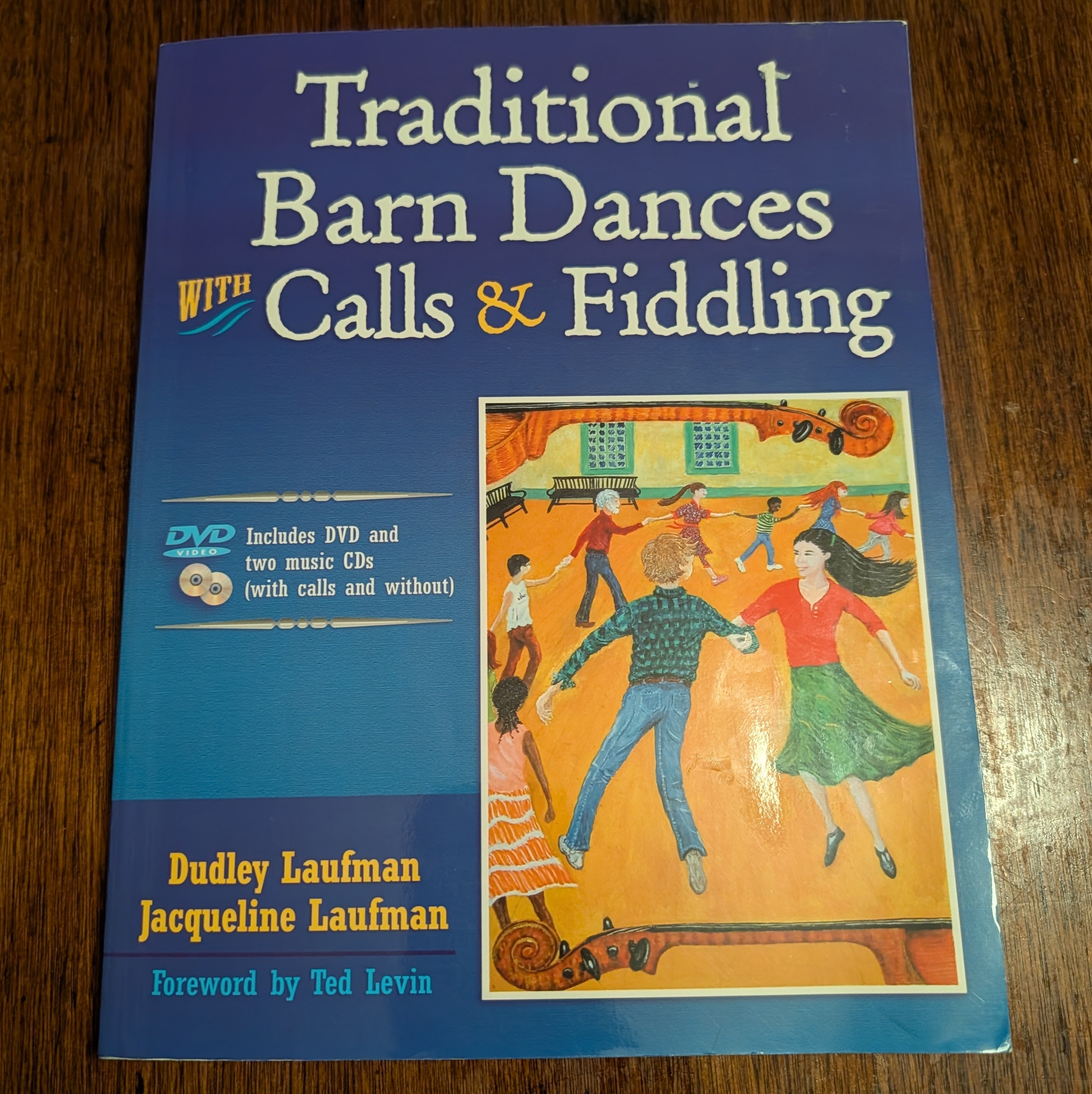
As with my notes on Tony Parkes' book, I'm more interested in what it tells us about its authors and its context than in its primary purpose as a dance instruction book.
The feel of the book is formal and institutional, a bit stilted, with sentences like "Be certain to ask the caller if he or she is able to...". Passive voice, very structured prose, avoiding contractions. A bit like real advice coming from a wooden puppet: "Do not worry about calling the dances on the phrase", "Request that the caller not do contra dances of the "duple proper" variety", and "Emphasize to the caller that folks are coming to a dance party for a social good time. They are not paying their way in to attend a workshop or listen to lengthy explanations and walk-throughs of complicated figures." The content is folk but the presentation is not folky. I'd speculate Dudley didn't draft (Jacqueline wrote many educational books), the publisher had a strong house style, or both.
Here's what they have to say on hiring musicians:
Live music is better than recorded music, even if it is only a harmonica. The caller you hire may prefer to select a band whose repertoire coincides with the dances and tunes he or she uses.If you expect a small dance (i.e., fewer than 40 people), it may be plenty to have just one musician (fiddler or accordionist) and a caller. This is a reasonable approach if there is not much money available to pay for more musicians.
A larger dance should have at least one fiddler and a guitar, standup bass, or piano player, as well as a small sound system. Anything over 120 attendees should have at least three musicians. Other instruments that make up traditional barn dance bands include mandolin, banjo, accordion, pennywhistle, flute, and cello. Brass instrument players must be very good in order to play in the keys that fiddlers tend to use.
A sound system for a big crowd will cost an additional amount, though it may be included in the band's fee if they bring a system. Sometimes, however, if the hall's acoustics are good, only the caller needs a microphone.
In the 1800s and 1900s, dance orchestras from New England typically included fiddles, coronet [sic], and string bass. Today, a nice full sound is provided by two fiddles, string bass, piano, and accordion.
The opening preference against recorded music is very strong, and is consistent with a vague memory I have of Dudley saying something along the lines of that he'd rather dance to an out of tune fiddle played by someone who only knew one tune than any recording. This is the kind of "live music above all else" push that Enid Cocke was reacting to.
At the same time, the context here is a book that has "With Calls & Fiddling" right in the title. It ships with "Two CDs of authentic fiddle tunes for many of the dances with the calls on one track followed by the music track without calls." So there's still some pragmatism: in practice most of the teachers this book is aimed at will be facilitating dancing to recorded music. And the authors accept this:
Eventually, the day will come when you simply pick up one of the CDs, hit "Play," and, without even opening the book, see everyone start dancing, regardless of whether it's you doing the calls, or Dudley, or no one calling—which is the way it always was, because everyone knew the dances.
I was glad to see them push, though, for getting students playing for dancing:
Older orchestra students, especially those in middle school and above, can learn to play music for a dance. In fact, string students and their teachers can meet national standards of the American String Teacher Association by playing fiddle tunes and learning the dances in a mainstream classroom setting. It is crucial to keep the music at dance tempo, as heard on the CDs that accompany this book, since a slow tempo drags the dancing down and thus tends not to work. (For this reason, younger students, who struggle to play the tunes up to tempo, may need to wait a few years before playing music for a dance.)You may find students eager to play for your dance or to hold a dance for themselves and take turns playing the music. Having older students play while younger ones dance can inspire the young ones to practice their fiddle tunes and learn to play for a dance like the big kids. Let them experience being part of living history as the fiddling tradition continues and is passed down to the next generation—themselves!
Overall this wasn't really the book for me, nor was I the intended audience. But Dudley and Jacqueline's extensive experience with barn dance crowds did come through the overly formal prose, and I do now have a citable source for something close to my memory of Dudley's very strong preference for live music.
[1] Very nearly to the day. If I were a more patient blogger I would
have waited a week to be able to make it an even twenty.
Comment via: facebook, lesswrong, mastodon, bluesky