Notes on Tony Parkes' "Contra Dance Calling" |
July 10th, 2026 |
| contra, dance |
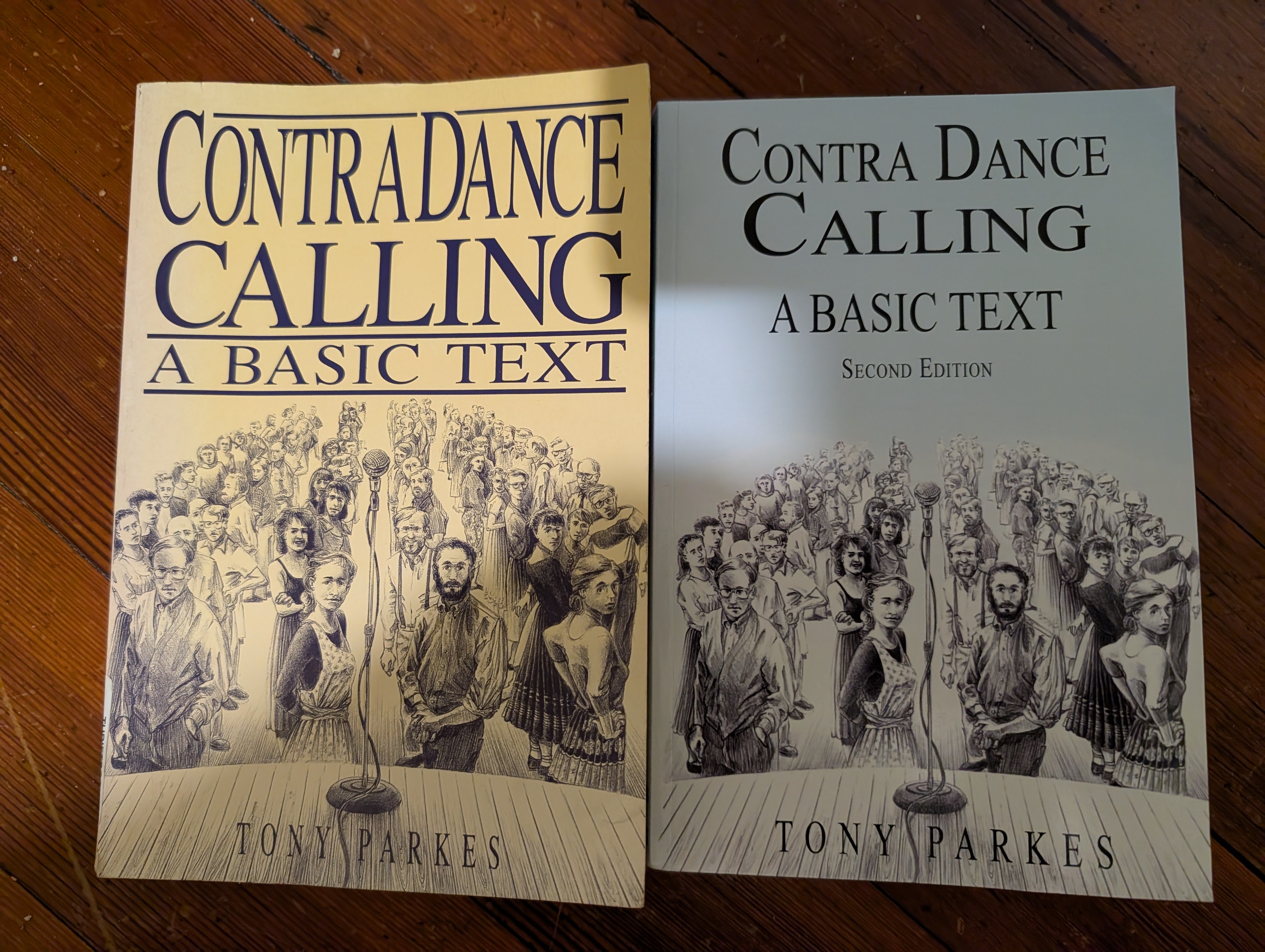
I read the whole 1992 first edition, then skimmed the 2010 second edition with the older one open at the same time, looking for changes. My notes:
I'm mostly interested in it for what it tells us about the community and practice over time, but as what it intends to be—a thorough introduction to the practice of contra dance calling—it succeeds very well.
I'm sad I didn't read it a few years earlier so I could ask him questions about it!
-
Parkes' tempos are high: "[120bpm] is the tempo adopted by the army for comfortable long-term marching, and it has been standard in contra dancing for several generations. The tempo can be varied during an evening, to provide contrasts in energy or excitement level, but should probably not be altered by more than about eight beats per minute either way (down to 112 or up to 128)." Parkes was a piano player in addition to a caller, very into musical theater, and knew what he was talking about, so I would take his numbers literally.
I usually tell people (ex) 108-122, and I expect if I played even 126 today I'd have some people pretty grumpy with me. I know several bands that like to hang out at 110, and I've had folks tell me never to play over 120bpm. I don't know if this represents a change over the years (though he keeps the same numbers in the 2010 edition) or was somewhat idiosyncratic all along?
Parkes preferred dances on the longer end: "My feeling is that ten minutes is about right for experienced dancers. For beginners or people beyond retirement age, you may want to reduce your sets to five or six minutes. Most square and contra dance records run between three and four minutes; if you're calling contras to recorded music, you can play a record twice or use two different records for each dance. Traditionally, contras were danced "all the way down and all the way back"; that is, until the original head couple had worked their way to the foot of the line and then up to the head again. This was necessary to ensure everyone received an equal amount of dancing, because prior to the 1950s, most contra routines resulted in at least half the couples standing still for significant portions of the time" I think of 8-9 minutes as typical. This does feed into a theory of mine that part of what contra dance kept live music might have been that recordings (and 45s) were too short for everyone to get a turn to be actives.
Parkes doesn't describe a "four potato" start: "Most bands prefer to start each number with a four-beat introduction. This typically takes one of two forms: a shuffle on the fiddle ('dah-didi-dah-didi-dah-didi-dah') or a piano vamp consisting of four 'oom-pahs'." I think of this as something that had mostly ended by 1992 in favor of four potatoes, though he did keep this in the 2010 revision.
-
He has a bit on recordings vs live music:
Someone once said "Good records are better than a bad band." This is a half-truth at best. The finest records available, chosen with care to fit each dance and played through a top-quality sound system, are better in some ways than an unsteady or indifferent band. Some, but not all. With even the worst live band there is still that sense of immediacy that no record can match.
Even so, recorded music can be a lifesaver in certain situations. A dance group newly formed, in an area where no one seems to know any dance musicians, will rejoice in the availability of good square and contra dance music on records and tapes. Some groups, such as small churches and parent-teacher organizations, that would love to try square dancing but whose budgets genuinely will not allow for live music, may have to hire a caller with records or forgo the activity altogether. Often such groups enjoy their initial taste of dancing so much that they hire the same caller again, this time with a live band!
The key to using records successfully is to take advantage of their strong points. I hesitate to term them "advantages," but recorded music does have certain strengths:...
I'd describe this as overall in favor of live music, but in a way that's more "pragmatic" than "principled".
Here's another bit that's pragmatic, and with building up beginner musicians to play for dancing as a clear goal:
The talent of the musicians you find will range from outstanding to minimal. If everyone you find seems to be at one extreme or the other, don't panic. Expert instrumentalists may welcome a steady local job. If you hold your series on a weeknight, you may be able to hire top-drawer talent for less money than they'd ask for a Saturday concert. Beginning or casual musicians, on the other hand, may be happy to play for the experience and exposure (and a little gas money). Even total beginners may be an asset to your dance: they can play for one or two numbers in an evening while you use recorded music for the rest, and work their way up to a full evening.
-
Comparing the two editions, the most common changes are technological: "recordings" instead of "records" or "tapes", updated listings of recommended sound equipment manufacturers. The 2010 edition predates the gypsy discourse and the mainstream shift to gender-free calling, but it does add discussion of the early days of this shift and calling gender-free for LGBT groups:
This leads to the third approach, inventing new names for the sex roles. In the past twenty years or so, this has become the prevailing method of dealing with the issue. Many different names have been tried: A few leaders have used "ones" and "twos" (in squares and contras, of course, those terms have other meanings). More common are names like "reds" and "blues," "lions" and "tigers," and "moons" and "stars." With such neutral names, it can be a challenge to remember which name refers to which role. To the dancers, it doesn't matter, but the caller must keep track of who is on the right side in each couple, and of who must do what in an adapted traditional routine. My wife Beth often uses "birdie" for "lady" and "crow" for "gent," from the traditional square dance Birdie in the Cage. This has two advantages: it's easy for the caller to remember which role is which, and the new names have the same number of syllables as the old ones and can be readily substituted when calling in rhythm.
In addition to new names, dancers can be distinguished by articles of clothing such as armbands, vests, or loose cloth yokes. Typically, only one member of each couple is so equipped. In a single-sex group, it will be the person playing the "opposite" role, and in a gender-free group, it is likely to be the person playing the "lead" or "gent". Chris Ricciotti, a pioneer in the LGBT contra dance field, refers to the roles as "armbands" and "bare-arms," or "bands" and "bares" for short—although his dancers now wear short clip-on ribbons rather than full armbands. Hats are less practical than armbands or yokes because they come off easily, can muss the hair, and are sometimes suspected of carrying head lice.
The 1992 book is printed on significantly higher quality paper, and with better print quality.
Comment via: facebook, lesswrong, mastodon, bluesky