Canterbury Country Dance Orchestra Liner Notes |
July 26th, 2026 |
| contra, music |
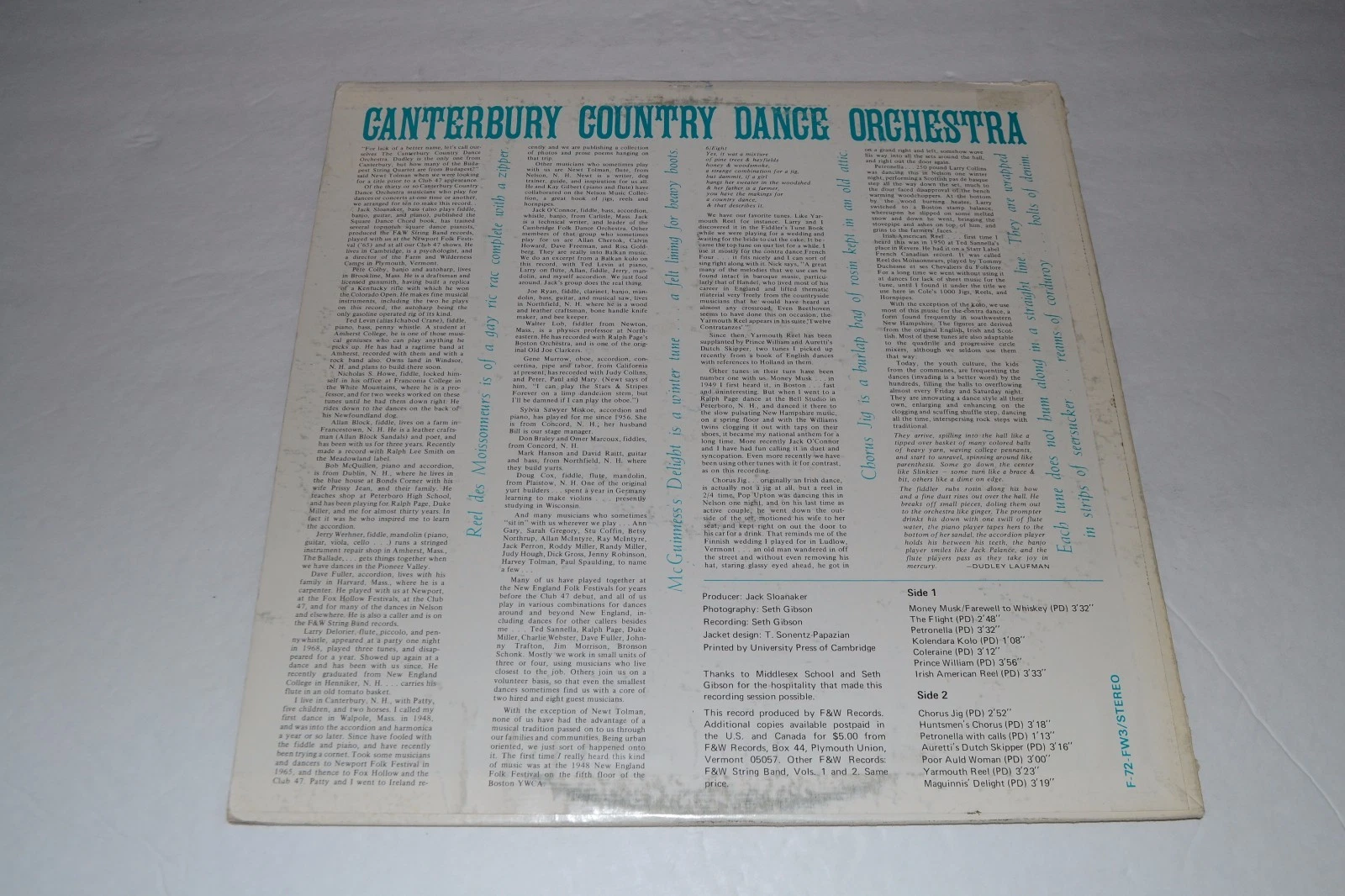
I couldn't find the text of these anywhere, so I had an LLM convert them to text and manually cleaned up the output:
"For lack of a better name, let's call ourselves The Canterbury Country Dance Orchestra. Dudley is the only one from Canterbury, but how many of the Budapest String Quartet are from Budapest?" said Newt Tolman when we were looking for a title prior to a Club 47 appearance. Of the thirty or so Canterbury Country Dance Orchestra musicians who play for dances or concerts at one time or another, we arranged for ten to make this record.Jack Sloanaker, bass (also plays fiddle, banjo, guitar, and piano), published the Square Dance Chord book, has trained several topnotch square dance pianists, produced the F&W String Band records, played with us at the Newport Folk Festival ('65) and at all our Club 47 shows. He lives in Cambridge, is a psychologist, and a director of the Farm and Wilderness Camps in Plymouth, Vermont.
Pete Colby, banjo and autoharp, lives in Brookline, Mass. He is a draftsman and licensed gunsmith, having built a replica of a Kentucky rifle with which he won the Colorado Open. He makes fine musical instruments, including the two he plays on this record, the autoharp being the only gasoline operated rig of its kind.
Ted Levin (alias Ichabod Crane), fiddle, piano, bass, penny whistle. A student at Amherst College, he is one of those musical geniuses who can play anything he picks up. He has had a ragtime band at Amherst, recorded with them and with a rock band also. Owns land in Windsor, N. H. and plans to build there soon.,
Nicholas S. Howe, fiddle, locked himself in his office at Franconia College in the White Mountains, where he is a professor, and for two weeks worked on these tunes until he had them down right. He rides down to the dances on the back of his Newfoundland dog.
Allan Block, fiddle, lives on a farm in Francestown, N. H. He is a leather craftsman (Allan Block Sandals) and poet, and has been with us for three years. Recently made a record with Ralph Lee Smith on the Meadowland label.
Bob McQuillen, piano and accordion, is from Dublin, N. H., where he lives in the blue house at Bonds Corner with his wife Prissy Jean, and their family. He teaches shop at Peterboro High School, and has been playing for Ralph Page, Duke Miller, and me for almost thirty years. In fact it was he who inspired me to learn the accordion. Jerry Werhner, fiddle, mandolin (piano, guitar, viola, cello ...) runs a stringed instrument repair shop in Amherst, Mass., The Ballade, ... gets things together when we have dances in the Pioneer Valley.
Dave Fuller, accordion, lives with his family in Harvard, Mass., where he is a carpenter. He played with us at Newport, at the Fox Hollow Festivals, at the Club 47, and for many of the dances in Nelson and elsewhere. He is also a caller and is on the F&W String Band records. Larry Delorier, flute, piccolo, and penny whistle, appeared at a party one night in 1968, played three tunes, and disappeared for a year. Showed up again at a dance and has been with us since. He recently graduated from New England College in Henniker, N. H. ... carries his flute in an old tomato basket.
I live in Canterbury, N. H., with Patty, five children, and two horses. I called my first dance in Walpole, Mass. in 1948, and was into the accordion and harmonica a year or so later. Since have fooled with the fiddle and piano, and have recently been trying a cornet. Took some musicians and dancers to Newport Folk Festival in 1965, and thence to Fox Hollow and the Club 47. Patty and I went to Ireland recently and we are publishing a collection of photos and prose poems hanging on that trip.
Other musicians who sometimes play with us are Newt Tolman, flute, from Nelson, N. H. Newt is a writer, dog trainer, guide, and inspiration for us all. He and Kay Gilbert (piano and flute) have collaborated on the Nelson Music Collection, a great book of jigs, reels and hornpipes.
Jack O'Connor, fiddle, bass, accordion, whistle, banjo, from Carlisle, Mass. Jack is a technical writer, and leader of the Cambridge Folk Dance Orchestra. Other members of that group who sometimes play for us are Allan Chertok, Calvin Howard, Dave Freeman, and Risa Goldberg. They are really into Balkan music. We do an excerpt from a Balkan kolo on this record, with Ted Levin at piano, Larry on flute, Allan, fiddle, Jerry, mandolin, and myself accordion. We just fool around. Jack's group does the real thing.
Joe Ryan, fiddle, clarinet, banjo, mandolin, bass, guitar, and musical saw, lives in Northfield, N. H. where he is a wood and leather craftsman, bone handle knife maker, and bee keeper.
Walter Lob, fiddler from Newton, Mass., is a physics professor at Northeastern. He has recorded with Ralph Page's Boston Orchestra, and is one of the original Old Joe Clarkers.
Gene Murrow, oboe, accordion, concertina, pipe and tabor, from California at present, has recorded with Judy Collins, and Peter, Paul and Mary. (Newt says of him, "I can play the Stars & Stripes Forever on a limp dandelion stem, but I'll be damned if I can play the oboe.")
Sylvia Sawyer Miskoe, accordion and piano, has played for me since 1956. She is from Concord, N. H.; her husband Bill is our stage manager.
Don Braley and Omer Marcoux, fiddles, from Concord, N. H. Mark Hanson and David Raitt, guitar and bass, from Northfield, N. H. where they build yurts.
Doug Cox, fiddle, flute, mandolin, from Plaistow, N. H. One of the original yurt builders ... spent a year in Germany learning to make violins ... presently studying in Wisconsin.
And many musicians who sometimes "sit in" with us wherever we play ... Ann Gary, Sarah Gregory, Stu Coffin, Betsy Northrup, Allan McIntyre, Ray McIntyre, Jack Perron, Roddy Miller, Randy Miller, Judy Hough, Dick Gross, Jenny Robinson, Harvey Tolman, Paul Spaulding, to name a few ...
Many of us have played together at the New England Folk Festivals for years before the Club 47 debut, and all of us play in various combinations for dances around and beyond New England, including dances for other callers besides me . . . Ted Sannella, Ralph Page, Duke Miller, Charlie Webster, Dave Fuller, Johnny Trafton, Jim Morrison, Bronson Schonk. Mostly we work in small units of three or four, using musicians who live closest to the job. Others join us on a volunteer basis, so that even the smallest dances sometimes find us with a core of two hired and eight guest musicians.
With the exception of Newt Tolman, none of us have had the advantage of a musical tradition passed on to us through our families and communities. Being urban oriented, we just sort of happened onto it. The first time I really heard this kind of music was at the 1948 New England Folk Festival on the fifth floor of the Boston YWCA.
6/Eight
Yes, it was a mixture
of pine trees & hayfields
honey & woodsmoke,
a strange combination for a jig,
but dammit, if a girl
hangs her sweater in the woodshed
& her father is a farmer,
you have the makings for
a country dance,
& that describes it.
We have our favorite tunes. Like Yarmouth Reel for instance. Larry and I discovered it in the Fiddler's Tune Book while we were playing for a wedding and waiting for the bride to cut the cake. It became the top tune on our list for a while. I use it mostly for the contra dance French Four ... it fits nicely and I can sort of sing right along with it. Nick says, "A great many of the melodies that we use can be found intact in baroque music, particularly that of Handel, who lived most of his career in England and lifted thematic material very freely from the countryside musicians that he would have heard at almost any crossroad. Even Beethoven seems to have done this on occasion; the Yarmouth Reel appears in his suite 'Twelve Contratanzes.'"
Since then, Yarmouth Reel has been supplanted by Prince William and Auretti's Dutch Skipper, two tunes I picked up recently from a book of English dances with references to Holland in them. Other tunes in their turn have been number one with us. Money Musk ... in 1949 I first heard it, in Boston ... fast and uninteresting. But when I went to a Ralph Page dance at the Bell Studio in Peterboro, N. H., and danced it there to the slow pulsating New Hampshire music, on a spring floor and with the Williams twins clogging it out with taps on their shoes, it became my national anthem for a long time. More recently Jack O'Connor and I have had fun calling it in duet and syncopation. Even more recently we have been using other tunes with it for contrast, as on this recording. Chorus Jig ... originally an Irish dance, is actually not a jig at all, but a reel in 2/4 time. Pop Upton was dancing this in Nelson one night, and on his last time as active couple, he went down the outside of the set, motioned his wife to her seat, and kept right on out the door to his car for a drink. That reminds me of the Finnish wedding I played for in Ludlow, Vermont ... an old man wandered in off the street and without even removing his hat, staring glassy eyed ahead, he got in on a grand right and left, somehow wove his way into all the sets around the hall, and right out the door again.
Petronella ... 250 pound Larry Collins was dancing this in Nelson one winter night, performing a Scottish pas de basque step all the way down the set, much to the door faced disapproval of the bench warming woodchoppers. At the bottom by the wood burning heater, Larry switched to a Boston stamp balance, whereupon he slipped on some melted snow and down he went, bringing the stovepipe and ashes on top of him, and grins to the farmers' faces.
Irish American Reel . . . first time I heard this was in 1950 at Ted Sannella's place in Revere. He had it on a Starr Label French Canadian record. It was called Reel des Moissonneurs, played by Tommy Duchesne et ses Chevaliers du Folklore. For a long time we went without using it at dances for lack of sheet music for the tune, until I found it under the title we use here in Cole's 1000 Jigs, Reels, and Hornpipes.
With the exception of the kolo, we use most of this music for the contra dance, a form found frequently in southwestern New Hampshire. The figures are derived from the original English, Irish and Scottish. Most of these tunes are also adaptable to the quadrille and progressive circle mixers, although we seldom use them that way. Today, the youth culture, the kids from the communes, are frequenting the dances (invading is a better word) by the hundreds, filling the halls to overflowing almost every Friday and Saturday night. They are innovating a dance style all their own, enlarging and enhancing on the clogging and scuffing shuffle step, dancing all the time, interspersing rock steps with traditional.
They arrive, spilling into the hall like a tipped over basket of many colored balls of heavy yarn, waving college pennants, and start to unravel, spinning around like parenthesis. Some go down the center like Slinkies - some turn like a brace & bit, others like a dime on edge.
The fiddler rubs rosin along his bow and a fine dust rises out over the hall. He breaks off small pieces, doling them out to the orchestra like ginger. The prompter drinks his down with one swill of flute water, the piano player tapes hers to the bottom of her sandal, the accordion player holds his between his teeth, the banjo player smiles like Jack Palance, and the flute players pass as they take joy in mercury. — DUDLEY LAUFMAN
Notes:
Newt Tolman (ex-husband of Beth Tolman, who wrote the 1937 Country Dance Book with Ralph Page) is the only one who grew up in the tradition. Makes sense given that this is a revival album, but it's still a more lopsided ratio than I'd have guessed.
Lots of people turning up to play for free as guests. People doing this part time because they love it.
Looking at the full-time occupations, it's all over the map. Psychologist and Summer Camp Director; draftsman and gunsmith; college student; two professors; leather craftsman and poet; shop teacher; carpenter; writer and dog trainer; technical writer; wood and leather craftsman, bone handle knife maker, and bee keeper. Dance musicians still have a wide variety of day jobs, but these days a list this long without a programmer (or where the only teachers are professors and a shop teacher) would be surprising.
Neat to see Laufman's contemporaneous description of the youth influx.
Comment via: facebook, lesswrong, mastodon, bluesky