Blinky Lights |
October 21st, 2018 |
| contra, jammer, music |
        dh             acc
  fh    dh             acc
  fh                   acc
  fh                   sax
That's saying I:
- turned on high drums
- turned on high footbass
- turned off high drums
- switched buttons from accordion to sax
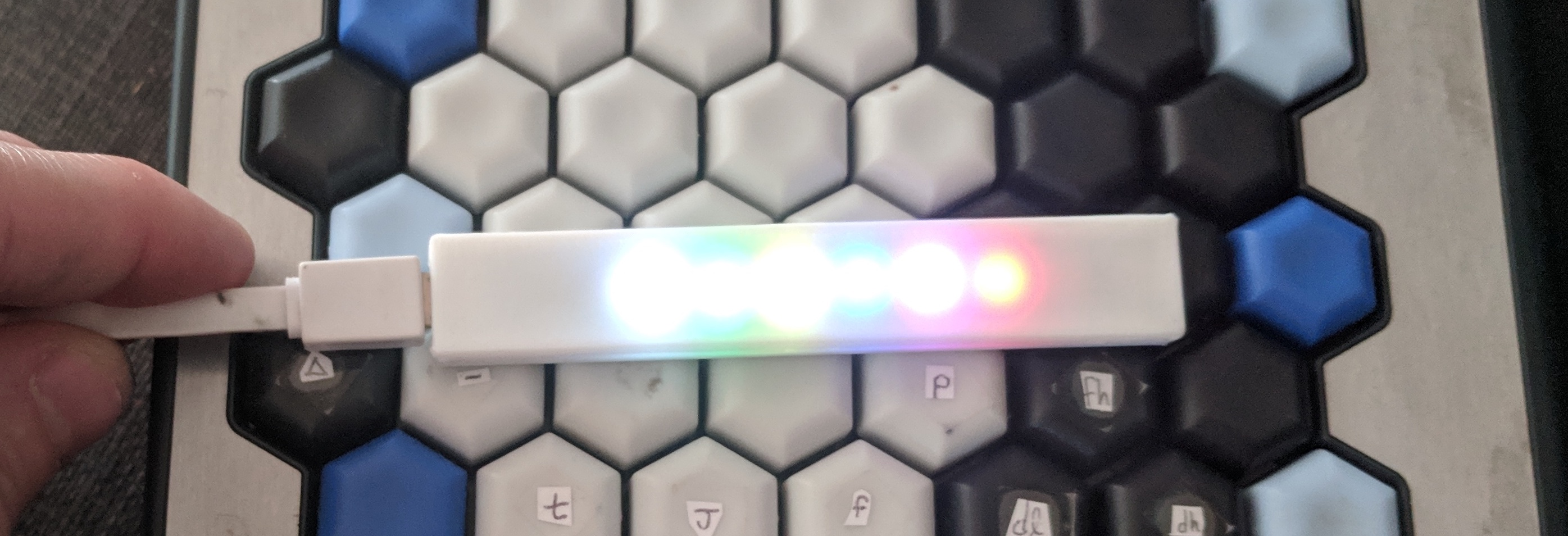
I have the lights set at 20% brightness for now; I find that at full brightness they're painful to look at. Stages are usually reasonably dark, so this seems about right. They're still too bright for my camera to do a good job with, though.
For most of this project I've been using as low level a Mac API as
possible because I want to minimize latency, this isn't needed with
status lights. It comes with a python interface (blinkstick-python)
and I wrote a little UDP wrapper (blinksticknet)
which I've now updated my central code to use (jammermidilib.h:set_light).
The protocol is just four byte udp packets: one byte for which light,
then one byte each for red, green, and blue channels. Here's what
this looks like end to end:
(The thing I'm demonstrating at the beginning is that for me left foot I can have it make any combination of drums / no drums and bass / no bass. I'm representing this with one light that can be red or not, and blue or not, with purple for when they're both on at once.)
Comment via: google plus, facebook, substack