Text-to-Speech Speed

June 4th, 2017
ideas, tech
Interacting with phones by talking to them has gotten enormously better over the past few years, to where for many tasks it's now the most efficient way to interact with them. For example, saying "set a reminder for 10:15pm: laundry" is really fast and switching to it has led me to set more reminders for myself.

One thing that makes this mode of interaction even better is having the speech go quickly. Not only can you talk to your phone quicker than you would talk to a person (try it!) you can set your phone to talk to you very quickly. (On Android, at least.)

On my phone this is Settings > Accessibility > Text-to-speech output > speech rate:
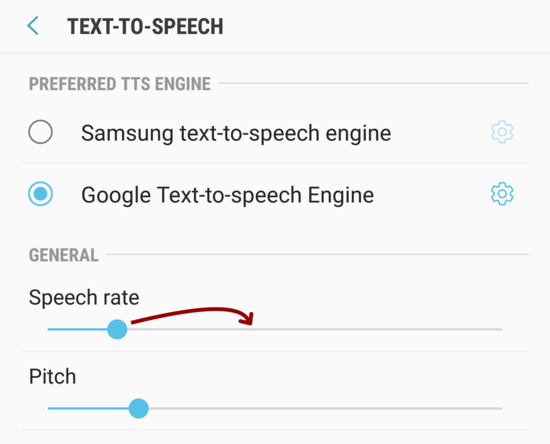
The main frustrating thing is that some apps, mostly Google ones, don't respect this setting. For example, if I ask a question to Google Assistant, it answers at its default (slow) rate. And while I can't reproduce it now, I believe Google Maps sometimes gives directions quickly (as I've set) and other times slowly (the default). I'm not sure what's going on, but my guess is that the setting only affects speech that is synthesized on-device, and some Google apps instead synthesize it on a server?

(I think this is an accessibility regression, because Assistant also doesn't respect your setting if you tell it talk slower. And this setting did used to apply to Assistant. Unfortunately, as an ex-googler I don't have a way to report bugs anymore.)

Comment via: google plus, facebook, substack

Recent posts on blogs I like:

Coping with shame

[Mod note: comments on this post about how I’m a good person who should feel better about myself will be deleted.

via Thing of Things August 4, 2026

Using AI to analyze life patterns

If you’re anything like me, you may have a lot of notes from various introspective activities – annual / monthly reviews, worksheets, therapy notes, etc. Often these notes are just gathering dust in a paper folder or some forgotten corner of Google Drive.…

via Victoria Krakovna July 30, 2026

Exercises in benchmarking and evals, part 7: DeepSWE, Senior SWE-Bench, napkin math, and winter tires

This is part of a series of exercises on benchmarking, evals, and experimental design (1, 2, 3, 4, 5, 6)1. We're going to look at three questions, which are presented before the answers to give you time to think about the questions before seeing the a…

via Posts on July 23, 2026

more     (via openring)