Tempo Meter |
January 4th, 2016 |
| music, tech |
How's our tempo? It looks like the dancers are rushing a bit, maybe? Is this too fast, or does it just feel fast?Over years of playing for dances I've built up a sense of how fast the music should go. If I'm playing a rhythm I'm fully comfortable with and stamping my foot I can hold down a nice even 116-118. If I'm winding through a challenging melody or otherwise distracted, though, my sense can get off, and I might end up at 108 or 128, both of which are pretty hard to dance to. Playing with other people can help here, as we're rarely all having tempo trouble at the same time, but disagreements are painful and potentially tense.
Several years ago it seemed to me that it would work well to have a box to show you how fast you were playing. The idea is you'd leave it one the floor in front of the band, and you could just look over at it if you were curious what tempo you were at. Well, the future is here:
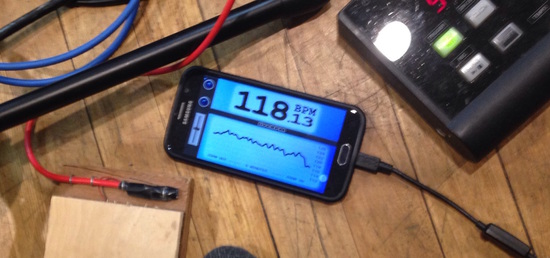
During the most recent Free Raisins tour we tried out putting a phone on the floor with BPM software. [1] It listens to what we're playing, figures out the current tempo, and displays that with nice big numbers. It was great! Non-intrusive, accurate, useful. Exactly what I'd hoped it would be. Definitely going to try this at future dances.
(I like the pitch-pipe:metronome::tuner:tempo-meter analogy. It's a lot easier to work with a device that tells you what you're currently doing than one that does something you're supposed to match. Plus we don't want to keep a robotic metronomic tempo.)
[1] We used liveBPM
on Stephen's recommendation. It's a paid app; if anyone knows an
accurate free app I'd be happy to point people there instead.
Comment via: google plus, facebook, r/WeAreTheMusicMakers, substack