Google Can't Math Parsecs |
June 20th, 2026 |
| tech |
As the earth travels around the sun, closer stars appear to shift back and forth against the distant background stars. The closer the star is the bigger this effect is. Think of how when you switch which eye you're looking through you notice near things shifting relative to farther ones. For example, holding up my finger I see this out of my right eye:
But this out of my left eye:
If a star moves by two arcseconds (each 1 / 3600th of a degree) as the earth goes halfway around the sun (two "astronomical units" apart) we say the star is 1 parsec away.
This defines a triangle where two of the sides are far larger than the third, which means as long as we measure our angle in radians we can use the small-angle approximation and say a parsec is one AU per arcsecond.
If I search [1 parsec in meters] I get the correct answer of 3e16 meters:
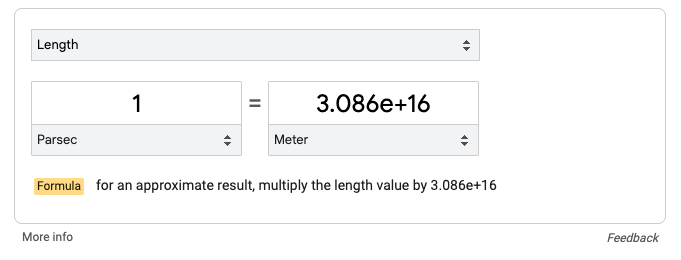 The interactive unit converter seems to be always right, but if we do
any math with it, even multiplying
it by one, we trigger a different flow that uses an incorrect
value of 5e14 meters:
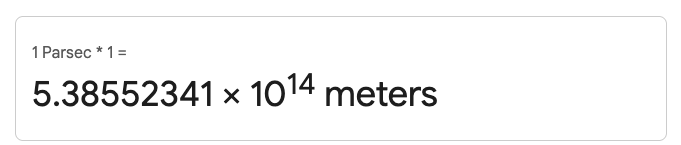
This is off by a factor of 57.3, a very suspicious number! It's the number of degrees in a radian (180 / PI). This is what you'd get if you took the definition of a parsec, 1 AU per arcsecond, but used arcsecond in degrees instead of radians.
For example, here's 1 au / 1 arcsecond in meters giving 5e14:

But then if I ask for it in parsecs it gives 1 parsec:
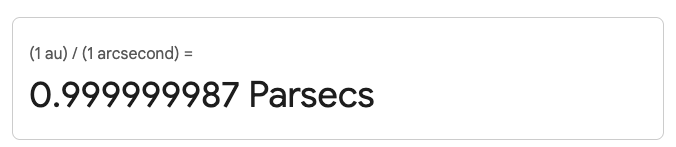
You could make a case for either of these, but not both at once! Similarly, [1 meter / 1 degree] gives "1 meter":

But so does [1 meter / 1 radian]:

I think the bug here is probably in some kind of clever context-dependent interpretation of angles, where they try to use either degrees or radians as appropriate. Or maybe it's confused because degrees and radians are dimensionless units? Regardless, "parsec" is expanding to "AU / arcsecond-in-degrees" and is off by a factor of 57.
This is not a unit of distance that is likely to come up in my daily life, but I hope no astronomers got bitten by this!
Comment via: facebook, lesswrong, mastodon, bluesky