Bitterness and Longevity |
June 10th, 2013 |
| health, taste |
We can test this. Give people various foods that there is dispute about the bitterness of, and then compare their preferences to their sensitivity to PTC or PROP. Several studies have done this:
- Genetic Taste Markers and Food Preferences (2001, n=121) found that people who could taste PROP better were more likely to say they didn't like cruciferous vegetables (broccoli, cabbage, etc).
- Taste and food preferences as predictors of dietary practices in young women (1999, n=157) found that "sensitivity to the bitter taste of PROP was associated with reduced preferences for Brussels sprouts, cabbage, spinach and coffee beverages". But it's behind a paywall, so this is just from the abstract. The same authors in a related study, Food preferences and reported frequencies of food consumption as predictors of current diet in young women (1999, n=87) found that people who reported liking cruciferous vegetables less ate them 1/3 as often.
- Bitter taste markers explain variability in vegetable sweetness, bitterness, and intake (2006, n=110) found that people "who taste PROP as most bitter also tasted the vegetables as most bitter and least sweet." This one is also paywalled, so I've only looked at the abstract.
Luckily, it turns out that this tasting ability is very strongly genetic. People with one variant of the gene TAS2R38 can nearly always taste PTC while people with another variant almost never can. So we can sample people at any age and get an estimate of how likely they were to have avoided vegetables for taste reasons. Are older people less likely to have the gene variant for tasting bitterness? It turns out they are. In Bitter Taste Receptor Polymorphisms and Human Aging (2012, n=941) they tested Calabrians (Sourthern Italians) for their bitterness gene variant, and did find that older people were less likely to have the variant for detecting bitterness:
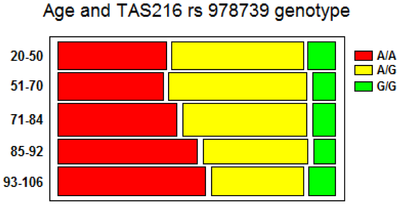
So can we say that (a) eating vegetables will help you live longer and (b) if vegetables taste bitter to you should eat them anyway to get benefit (a)? Unfortunately it's not that clear. Vegetables aren't the only common food with these bitterness compounds, so it might be something else. Other bitter-to-some foods that these non-bitter-tasters might have been eating more of include coffee, tea, grapefruit juice, soy, cigarettes (maybe), and probably other things we haven't tested. There's also the possibility that the older and younger participants in the longevity study aren't the same group of people genetically, and what they're actually capturing is population changes in Calabria. One way to test that would be to repeat the study in several different places, as we would expect population drift to be independent of sensitivity to bitterness.
Comment via: google plus, facebook, lesswrong, substack