Sticking out your tongue at babies

July 4th, 2012
cogsci
How much of what we know is learned and how much is inate is a really old question. Do we learn to use our senses and interpret the world from experience, or are we born knowing it? In college I believed we were born nearly a blank slate and that everything we knew was just a matter of applying powerful learning processes to our sensory input. And then a I read a paper:


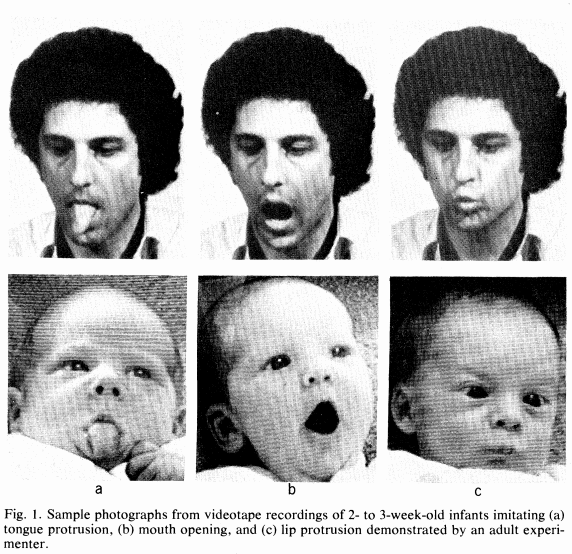
Imitation of Human and Manual Gestures by Human Neonates

Meltzoff and Moore experimented with making faces at infants [1], looking for imitation. They found it: when the experimenter stuck out their tongue, the baby was more likely than chance to do the same. Which is actually amazing: think about all the steps it takes for them to do this. They need to have a connection between their eyes seeing a change in the experimenter's mouth and activating the muscles in their own mouth in just the right way as to duplicate the gesture. This shattered my previous understanding of neural development, where babies learn how to interpret their senses and move their muscles with lots of practice and experimentation. There is certainly still some of that, but this shows several complex systems are working and connected right after the eyes get their first look at the world.


[1] They later repeated this experiment with newborns under 72 hours old and got similar results. (Imitation in Newborn Infants: Exploring the Range of Gestures Imitated and the Underlying Mechanisms)

Referenced in: Mind Changing Writing

Comment via: google plus, facebook, substack

Recent posts on blogs I like:

Coping with shame

[Mod note: comments on this post about how I’m a good person who should feel better about myself will be deleted.

via Thing of Things August 4, 2026

Using AI to analyze life patterns

If you’re anything like me, you may have a lot of notes from various introspective activities – annual / monthly reviews, worksheets, therapy notes, etc. Often these notes are just gathering dust in a paper folder or some forgotten corner of Google Drive.…

via Victoria Krakovna July 30, 2026

Exercises in benchmarking and evals, part 7: DeepSWE, Senior SWE-Bench, napkin math, and winter tires

This is part of a series of exercises on benchmarking, evals, and experimental design (1, 2, 3, 4, 5, 6)1. We're going to look at three questions, which are presented before the answers to give you time to think about the questions before seeing the a…

via Posts on July 23, 2026

more     (via openring)