Allow Babywearing Carriers on Planes |
September 8th, 2026 |
| airplanes, kids, policy |
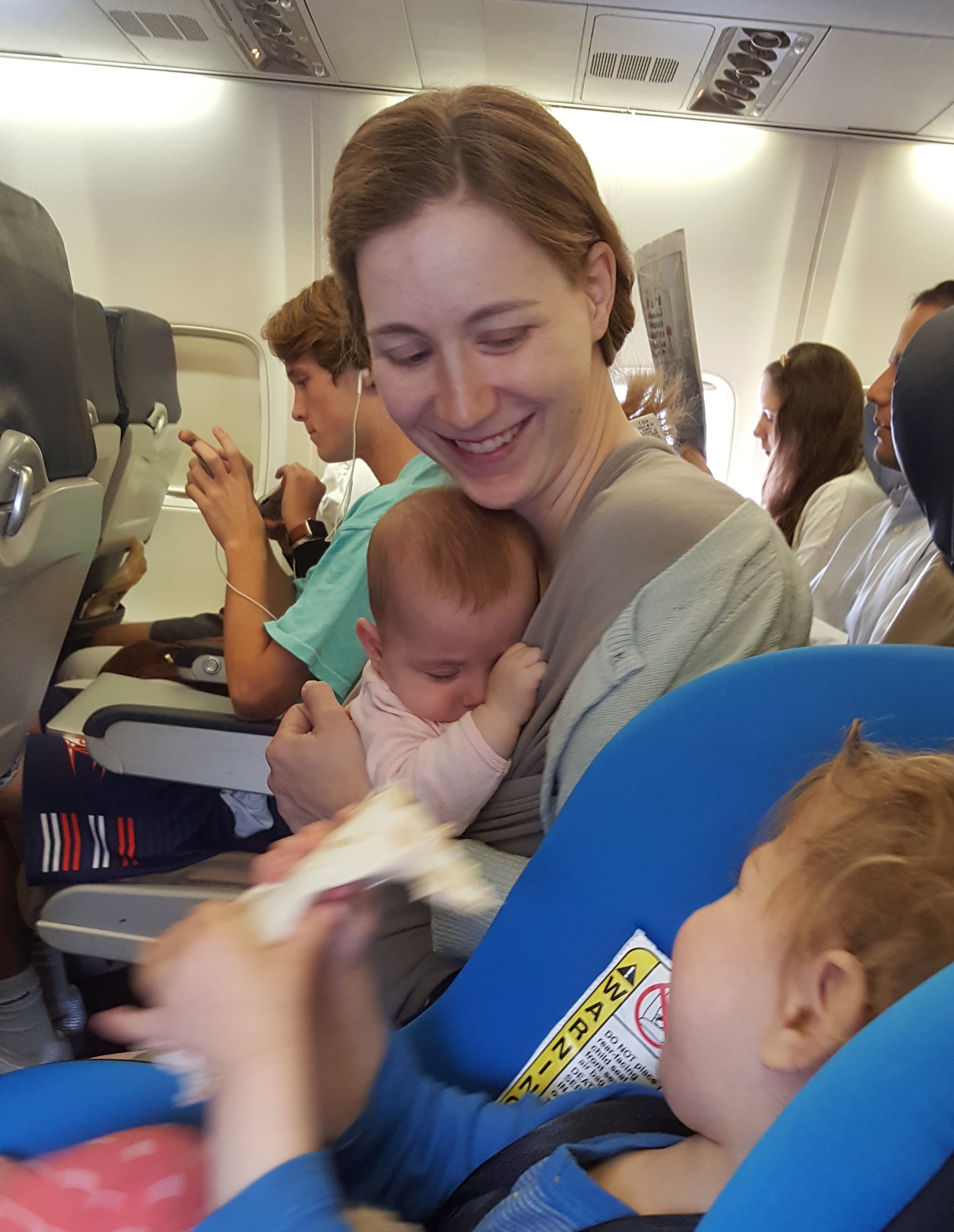
In fact, one specific place where I'd like to see this thinking applied is adjacent to this rule: babywearing carriers on planes. When our babies were little, carriers were massively helpful in flying. The baby likes it, and your arms are free. But for takeoff and landing, the FAA requires you to take your baby out of the carrier and hold them in your arms.
The rule is that if an under-two is going to ride on a lap, they must not "occupy or use any restraining device," (14 CFR 121.311.b.1) and FAA guidance to parents is clear: "Baby carriers ...are not allowed to be used during ground movement, take-off, or landing."
This goes back to 1995, and if you look at the notice of proposed rulemaking it says:
This notice proposes to withdraw FAA approval for the use of booster seats and vest- and harness-type child restraint systems in aircraft during takeoff, landing, and movement on the surface. ... The FAA believes that, during an aircraft crash, the banned devices may put children in a potentially worse situation than the allowable alternatives.
This is based on their 1994 study, where the FAA compared child restraint options. They looked at "booster seats, forward facing carriers, aft facing carriers, a harness device, a belly belt, and passenger seat lap belts." The "carriers" here are car seats; they didn't test babywearing carriers. I don't think that's a major flaw in the study, however, since I do expect babywearing carriers would have performed poorly. [1] The real problem is that they didn't test the most common alternative, holding the baby in your lap. So "may put children in a potentially worse situation than the allowable alternatives" seems clearly wrong to me.
In the 1996 final rule [2] they discuss why they're making a different decision than the UK (CAA) and Europe (JAA, predates EASA), and they avoid the obvious comparison. They say belly belts can be dangerous, acknowledge that lap-holding has risks, predict parents will buy a second seat, and then also say they don't want to require a second seat because people will drive. This isn't completely nuts, since it's possible that allowing belly belts would have caused some parents to choose them over a second seat. It's pretty unlikely for the effects to balance out in just this way, however, and I don't see any indication that they tried to do this balancing.
I expect that, if fairly evaluated, modern babywearing carriers would prove much safer than arms during turbulence, crashes, and evacuations. And I think this is likely enough that if we're not going to do these tests we should default to not banning carriers. In 2024 there was a bill proposing to do something like this (Rep Bill Posey's HR 8972), but it went to the aviation subcommittee and died without a vote.
I don't think the harm of the current rule is very large in the scheme of things: flying is very safe, even for unrestrained lap infants. Most of the harm is probably the inconvenience of waking happily sleeping babies. Still, it bugs me as a clear example of incoherent rulemaking. The FAA sensibly considered substitution behavior in deciding not to ban lap infants, but failed to balance it here.
[1] The closest thing to a carrier they tested was a 'belly belt':
"This belt is designed to be buckled around the child's abdomen and is
secured to an adult's abdomen with the adult's safety belt by routing
the safety belt through a small loop of webbing sewn on the belly
belt." They did not perform well: "In the test, these systems allowed
the anthropomorphic test dummy to make severe contact with the back of
the seat in the row in front of the test dummy. The child also may be
crushed by the forward bending motion of the adult to whom the child
is attached."
[2] Here's the section, if the PDF is hard to load or read:
CAA and JAA state that they permit the belly belt on the grounds that it provides a measure of protection to children and/or other passengers versus lap holding a child.
FAA Response: The FAA would like to emphasize that belly belts are not permitted under current regulations. Even if belly belts do provide some measure or protection, the CAMI study found that belly belts allowed the test dummy to make severe contact with the back of the seat in the row in front of the test dummy and that a child may be crushed by the forward bending motion of the adult to whom the child is attached. Consideration of revising this current prohibition is beyond the scope of the notice.
The JAA also stated that in a crash or severe air turbulence, parents are often unable to keep a lap-held child in their arms.
FAA Response: As discussed earlier, the FAA has determined that mandating child restraint devices could cause more deaths and injuries than it would prevent. However, the FAA does not encourage lap-holding children. The FAA expects, with its education campaign providing clear guidance on child restraint devices, parents will choose an approved device, rather than lap holding their children, in order to provide the safest traveling environment for their children. The two members of the APCS Working Group submitted identical letters that discussed the need to mandate restraints for children. In addition, they stated that the FAA's argument that the extra cost to families caused by mandating child restraint devices would force them to less safe road travel is invalid since the same cost situation arises when the child is 3 or 4 or 10 years old.
FAA Response: The APCS Working Group's argument is that the extra cost to families of mandating child restraint devices is no more of a deterrent to air travel than the price of a ticket for a child of any age. However, the FAA notes that this argument does not take into account that ordinarily there is no charge for a lap-held child, whereas certificate holders very often do charge if a seat is requested for this infant. Thus, many people would switch to less safe automobile travel as a result of mandating child restraint usage because unlike most rulemakings where the compliance costs are passed along to all travelers, mandatory use of child restraint would impose compliance costs only on families with infants.
Comment via: facebook, lesswrong, hacker news, mastodon, bluesky